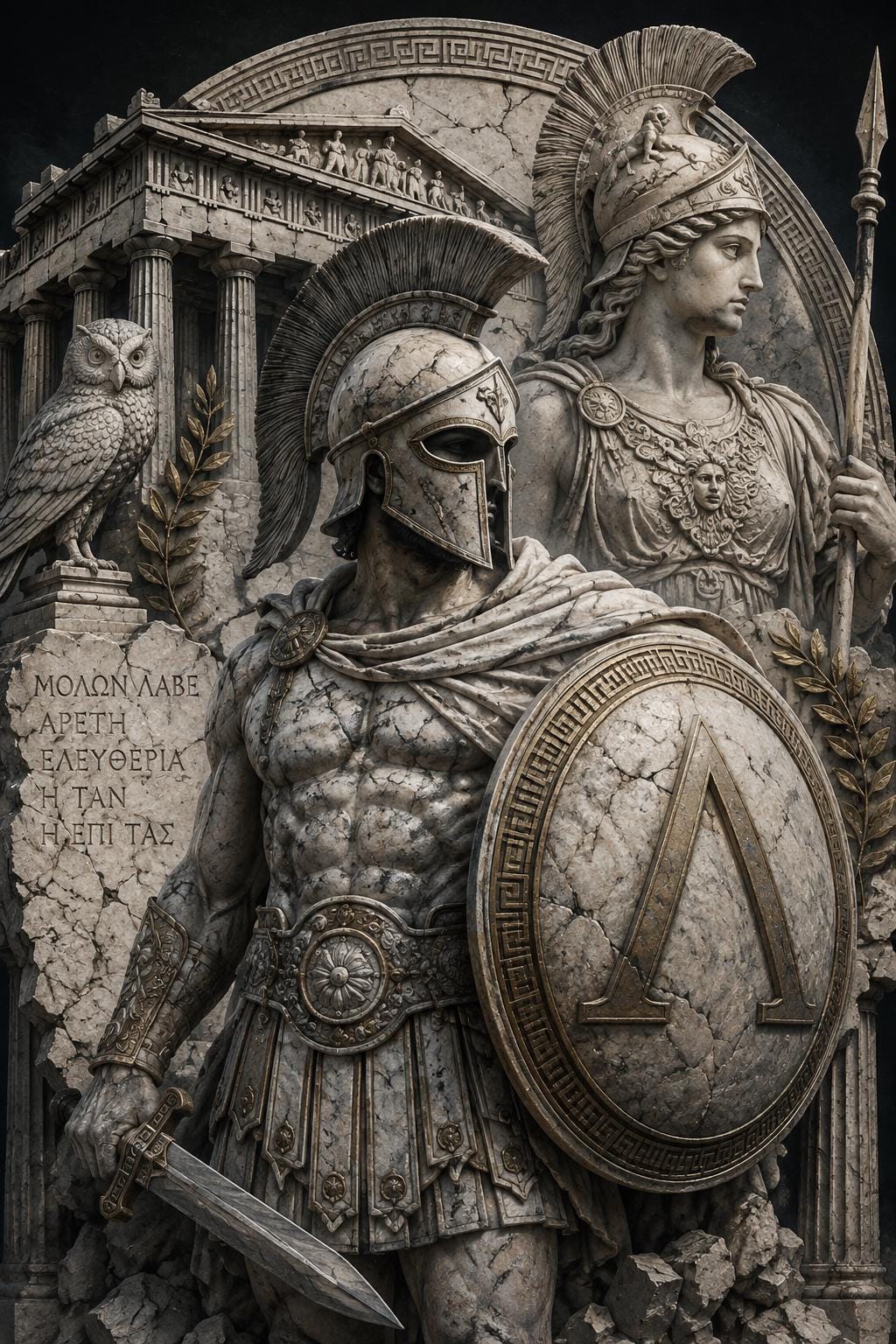
The Voices of Ancient Greece
For thousands of years, the stories of ancient Greece have spoken across generations. They tell of gods who possessed extraordinary power but displayed very human emotions, heroes who pursued glory despite impossible odds, warriors who faced death for honor and home, and ordinary people caught between their own choices and the forces of fate. These stories survived because their themes remain familiar. Courage, ambition, loyalty, rage, sacrifice, love, pride, wisdom, revenge, and the desire to return home are as recognizable today as they were to the people who first heard these tales. Greek mythology is ancient, but the questions it asks are timeless. That enduring connection is at the heart of Ancient Voices: looking beyond the ruins and names of the past to discover ideas that still have something to say.
What Is Greek Mythology?
Greek mythology is the collection of traditional stories developed and shared by the ancient Greeks to explain their gods, heroes, origins, customs, and understanding of the world. These stories were not contained in a single sacred book. They developed across centuries through oral tradition, poetry, drama, art, religious practice, and literature. The myths helped ancient Greeks make sense of forces they could not control. Storms, war, love, death, harvests, the sea, fortune, and fate could all be understood through stories involving divine powers. At the same time, mythology explored human behavior. Kings could become arrogant. Heroes could make disastrous choices. Gods could be jealous. Warriors could demonstrate extraordinary courage and still be defeated.Writers such as Homer and Hesiod helped preserve many of these traditions. Homer's Iliad and Odyssey became two of the most influential works associated with the ancient Greek world, while Hesiod's Theogony provided an important account of the origins and relationships of the Greek gods. Greek mythology was therefore more than entertainment. It was one of the ways ancient Greeks explored who they were, what they valued, and humanity's place in a world shaped by both choice and forces beyond human control.
The Gods and Goddesses of Ancient Greece
The Greek gods were powerful, but they were rarely perfect. They could display wisdom and courage alongside jealousy, anger, pride, deception, and vengeance. That combination of divine power and recognizable human behavior is one reason their stories have remained compelling. Zeus, ruler of the Olympian gods, represented authority, kingship, and the power of the sky. Poseidon ruled the sea and was associated with earthquakes and horses. Apollo was connected with prophecy, music, healing, archery, and light. Ares embodied the violent and brutal aspects of warfare. The Greek goddesses were equally important. Athena, goddess of wisdom and strategic warfare, became the patron goddess of Athens and one of the most recognizable figures in Greek mythology. Artemis was associated with the hunt and wilderness. Aphrodite represented love and beauty, while Hera, queen of the gods, was associated with marriage and royal authority. These gods and goddesses were not distant background characters. They intervened in wars, protected favored heroes, punished disrespect, competed with one another, and altered human lives. In Greek mythology, the boundary between the divine world and the human world was often remarkably thin.
Heroes Who Became Legends
Greek mythology is filled with heroes, but Greek heroes were not necessarily models of perfection. Their greatness often existed beside serious flaws. Courage could become recklessness. Confidence could become pride. Loyalty could demand sacrifice. The same qualities that made a hero extraordinary could also contribute to his downfall. Achilles represents perhaps the clearest example. The greatest Greek warrior in the Iliad, Achilles possesses extraordinary ability on the battlefield, yet his rage drives much of the poem's tragedy. His story forces us to consider the price of pride, anger, glory, and mortality. Odysseus represents a different kind of hero. He survives through intelligence, adaptability, endurance, and cunning. His greatest struggle is not simply defeating an enemy—it is surviving long enough to return to Ithaca after the Trojan War. Hector, prince of Troy, offers yet another vision of heroism. He fights not for adventure or conquest but in defense of his city, family, and people. He knows the danger he faces and nevertheless returns to battle.Heracles, Perseus, Theseus, and other legendary figures add still more interpretations of what it meant to be heroic. Greek mythology rarely presents greatness without a cost.
The Iliad, Troy and the Rage of Achilles
The Iliad does not tell the entire story of the Trojan War. Instead, it focuses on a relatively short period near the end of the conflict and begins with one overwhelming force: the rage of Achilles.The poem's opening invokes the Greek word μῆνις (mēnis)—a profound, destructive wrath. Achilles withdraws from battle after a dispute with Agamemnon, and the consequences of that anger spread far beyond the two men. Greek warriors die, relationships fracture, and the war moves toward increasingly personal tragedy. Across the battlefield stands Hector, Troy's greatest defender. His encounters with his wife Andromache and their young son reveal something important about Homer's world: behind every heroic battle are people who will bear its consequences. The Iliad explores honor, pride, mortality, friendship, grief, and the pursuit of glory. Even its greatest warriors cannot escape death. What remains is reputation—the memory of what a person did while alive. More than two thousand years later, Achilles and Hector still represent opposing but equally compelling images of the warrior: one pursuing immortal glory, the other defending everything he loves.
The Odyssey and the Journey Home
If the Iliad is dominated by rage and war, the Odyssey is shaped by a different desire: homecoming.The ancient Greek concept of νόστος (nostos) means a return home, particularly the return of a hero after a long journey. Odysseus spends ten years fighting at Troy and another ten struggling to return to his kingdom of Ithaca. His journey places him against monsters, storms, temptation, captivity, divine anger, and his own mistakes. He encounters the Cyclops Polyphemus, the enchantress Circe, the Sirens, Scylla and Charybdis, and years of separation from everything he once knew.Yet the destination never changes.Ithaca represents more than geography. It represents identity, family, responsibility, and belonging. Odysseus can be offered comfort and even immortality elsewhere, but his purpose remains the journey home. That is why the idea of nostos still resonates. The journey may change the traveler, the road may become almost impossible, and years may pass—but home remains the point toward which everything is directed.
Fate, Courage and the Ancient Greek Mind
Ancient Greek stories repeatedly return to the tension between human action and fate. The Greeks used the concept of μοῖρα (moira) to describe one's allotted portion or destiny. Even gods and heroes existed within a universe where certain outcomes could not simply be avoided through strength. Yet Greek mythology does not suggest that human action is meaningless. A warrior may not control whether he is mortal, but he can control how he faces danger. A king cannot control every circumstance, but he remains responsible for his decisions. Odysseus cannot command the sea, but he can continue navigating it. Another important Greek concept is ἀρετή (aretē)—often translated as excellence or virtue. It describes the fulfillment of one's potential and the pursuit of excellence in what one does. For a warrior, ruler, athlete, thinker, or citizen, excellence had to be demonstrated through action.This creates one of the enduring tensions within Greek thought: we may not control everything that happens to us, but our actions still reveal who we are. Fate establishes the boundary. Character determines how we meet it.
Why Greek Mythology Still Matters
Greek mythology continues to influence literature, film, art, philosophy, language, and popular culture because its stories deal with problems that never became ancient.We still understand Achilles' anger. We understand Hector's responsibility to family and country. We recognize Odysseus' longing for home. We understand Athena's association with wisdom and strategy and the fear represented by Medusa. We still wrestle with pride, ambition, mortality, loyalty, sacrifice, and fate.Many words and concepts rooted in Greek stories remain embedded in modern language. An "Achilles' heel" is still a vulnerability. An "odyssey" is still a long and difficult journey. A "Trojan horse" still describes something dangerous concealed inside something seemingly harmless.The civilization that created these stories is gone, but its ideas are not.That is ultimately why mythology survives. The gods may be ancient, the armor may belong to another age, and the cities may now be ruins, but the people within these stories confront emotions and choices that remain deeply human.
Ancient Voices: The Past Still Speaks
Ancient Voices was built around a simple idea: the past still has something to say. A single ancient word can carry an entire story. μῆνις recalls the rage that drives the Iliad. νόστος captures Odysseus' struggle to return home. μοῖρα speaks to fate and the limits of human control. ἀρετή challenges us to pursue excellence through action. The warriors, philosophers, myths, and languages of the ancient world survived because generations continued to find meaning in them. They remind us that courage does not require the absence of fear, that strength without wisdom can become destructive, that actions carry consequences, and that some journeys are defined not by how far we travel but by what we are trying to return to. JCohea Ancient Voices draws inspiration from those enduring stories and ideas, bringing elements of ancient mythology, history, language, and warrior culture into modern designs created for those who still find meaning in the voices of the past. The civilizations are ancient. The questions are timeless. The past still speaks.
Explore our Greek Roman Mythology collection, featuring designs inspired by the gods, heroes, warriors, legends, and enduring ideas of ancient Greece and Rome.