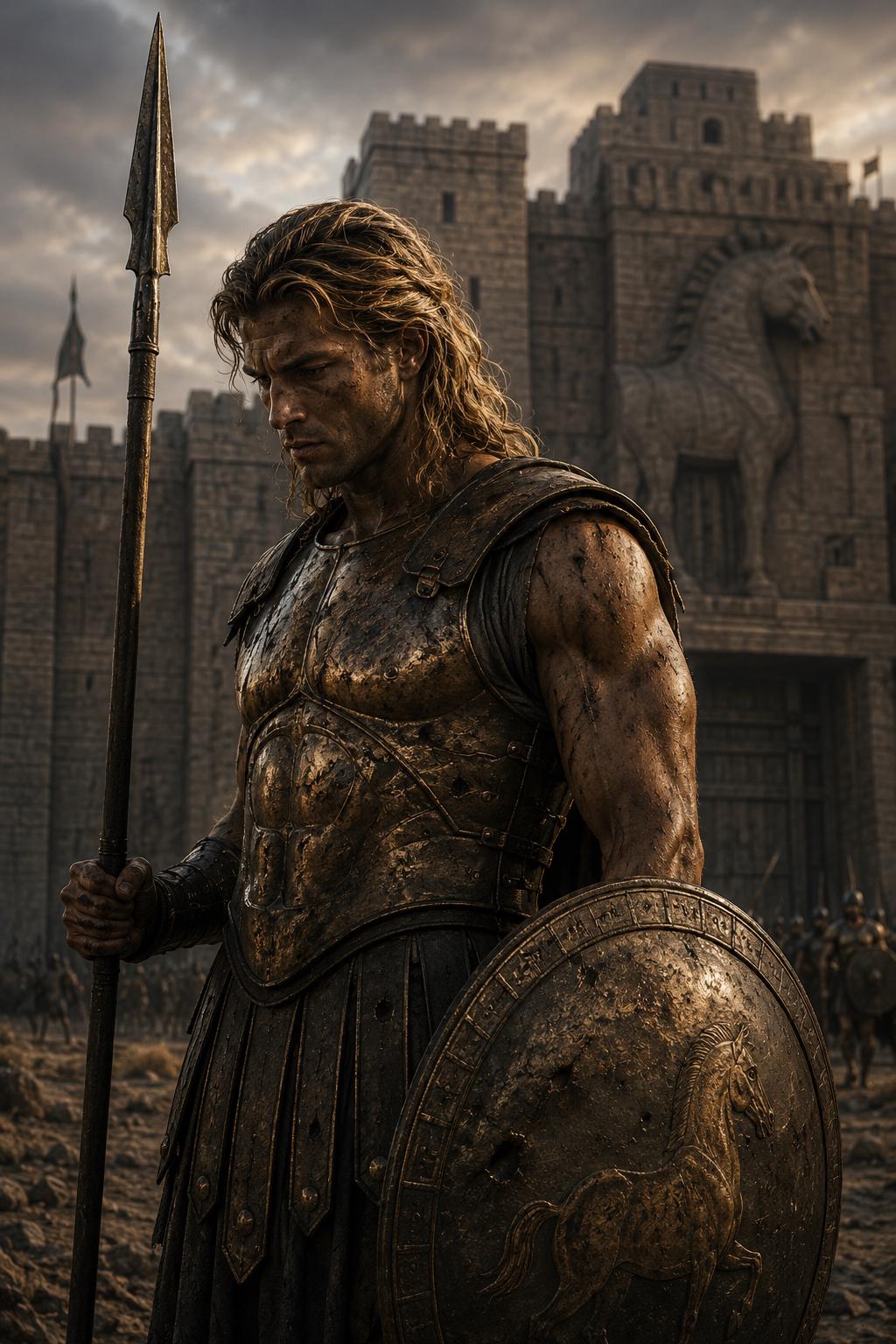
Achilles: The Greatest Warrior of Greek Mythology
Few heroes of Greek mythology embody the contradictions of heroism as powerfully as Achilles. He is extraordinarily gifted yet deeply vulnerable, capable of fierce loyalty and consuming anger, and destined for greatness at a terrible personal cost. In Homer’s Iliad, Achilles stands above the other Greek warriors fighting at Troy. His speed, strength, courage, and skill in battle make him nearly unstoppable. Yet the story that made him immortal is not simply about his ability to defeat enemies. It is about rage, honor, pride, friendship, grief, mortality, and the choices a person makes when confronted with an unavoidable fate. Thousands of years later, Achilles remains compelling because beneath the armor and legend is a profoundly human character.
The Rage of Achilles
The Iliad begins not with the fall of Troy, the Trojan Horse, or even a great battle, but with the rage of Achilles. The Greek word mēnis—μῆνις—describes an extraordinary form of wrath, and Achilles' anger becomes the force that drives much of the poem. His conflict begins when Agamemnon, commander of the Greek forces, takes Briseis from him, publicly attacking Achilles' honor and status. Achilles responds by withdrawing from battle. For a warrior whose identity is built around honor, this insult is more than personal humiliation. It challenges his place within the warrior society around him. His absence changes the course of the war and demonstrates one of the central lessons of the Iliad: immense strength does not necessarily mean mastery over oneself.
Honor and Glory in the Ancient Greek World
To understand Achilles, it helps to understand the importance of honor and glory in ancient Greek heroic culture. Honor was not merely an internal feeling of self-respect. A warrior's reputation was recognized publicly through achievement, courage, status, and the respect of others. Closely connected was kleos—κλέος—the fame or glory that survived after death. Achilles faces an extraordinary choice. He can return home and live a long life that will eventually be forgotten, or remain at Troy, die young, and achieve everlasting glory. He chooses glory. That decision captures one of the most powerful ideas in Greek heroic tradition: a mortal life may be brief, but a person's deeds can outlive the person who performed them.
Achilles and Patroclus
The relationship between Achilles and Patroclus provides the emotional center of Achilles' story. While Achilles refuses to fight, the Greeks suffer heavily against the Trojans. Patroclus eventually enters battle wearing Achilles' armor, hoping that his appearance will frighten the Trojans and relieve pressure on the Greek forces. Instead, Patroclus is killed by Hector. His death transforms Achilles. The insult from Agamemnon that once consumed him becomes insignificant beside the loss of his closest companion. Grief replaces wounded pride, and grief quickly becomes vengeance. Achilles returns to battle knowing that doing so will move him closer to his own death. His decision demonstrates that even the strongest warrior can be driven not by strategy or ambition, but by love, loyalty, sorrow, and rage.
Achilles and Hector
Hector, prince of Troy, provides a powerful contrast to Achilles. Achilles fights for personal honor and ultimately vengeance; Hector fights primarily to defend his city, family, and people. Their confrontation becomes one of the defining moments of the Trojan War tradition. Achilles kills Hector outside the walls of Troy and initially allows his rage to overcome restraint, dishonoring Hector's body. Yet the story does not end there. Hector's elderly father, King Priam, later enters the Greek camp and begs Achilles to return his son's body. Priam asks Achilles to remember his own father. For perhaps the most important moment in Achilles' story, the warrior sees beyond his own grief and recognizes the suffering of another human being. Achilles returns Hector's body. Rage gives way, however briefly, to compassion.
The Meaning of the Achilles Heel
Modern culture often associates Achilles with the phrase “Achilles heel,” meaning a critical weakness in someone who otherwise appears strong. Later Greek traditions told that Achilles' mother, Thetis, attempted to make him invulnerable, with his heel remaining vulnerable. That famous detail is not the central explanation of Achilles' vulnerability in Homer's Iliad. In the Homeric story, Achilles is an extraordinary warrior, but he remains mortal and knows that death awaits him. This distinction makes the original story even more powerful. Achilles does not demonstrate courage because he believes himself invincible. He continues forward despite knowing the consequences.
Arete: The Pursuit of Excellence
Another concept connected to Greek heroic culture is aretē—ἀρετή—often translated as excellence or virtue. For a warrior, excellence could mean courage, skill, strength, discipline, and fulfilling one's capabilities at the highest level. Achilles possesses extraordinary aretē on the battlefield. Yet his story also demonstrates the limitations of excellence without restraint. Physical greatness cannot prevent anger from clouding judgment. Courage cannot eliminate grief. Victory cannot restore someone who has been lost. The Greeks created heroes who were remarkable precisely because they were not perfect. Their strengths and weaknesses often existed side by side.
What Achilles Teaches About Strength
Achilles complicates the idea of what it means to be strong. His physical strength is obvious, but the Iliad repeatedly asks whether power alone is enough. Achilles can defeat almost anyone in battle, yet he struggles to control his anger. He can terrify armies, yet he cannot escape grief. He can achieve everlasting fame, yet he cannot escape mortality. His eventual encounter with Priam suggests another form of strength: the ability to recognize another person's suffering even while carrying one's own. The warrior who spends much of the poem consumed by rage ultimately demonstrates humanity through compassion.
Why Achilles Still Matters
More than two thousand years after the ancient Greeks told these stories, Achilles remains one of mythology's most recognizable warriors because his conflict is timeless. People still wrestle with pride, anger, loyalty, reputation, ambition, loss, and the desire to leave something meaningful behind. Most of us will never stand outside the walls of Troy, but the underlying questions remain familiar. What is worth sacrificing for? How much should reputation matter? When does confidence become pride? When does anger become destructive? What do we leave behind when our time is over? Achilles survives because his story does not provide easy answers.
Ancient Voices: Glory Has a Price
Achilles represents both the greatness and danger found within the ancient Greek heroic ideal. Courage matters. Excellence matters. Loyalty matters. Honor matters. But the Iliad also warns that uncontrolled rage carries consequences and that glory often demands sacrifice. Achilles becomes immortal not because he escapes death, but because his story survives it. That tension between strength and vulnerability is part of what inspires J.Cohea Ancient Voices. The warriors, words, myths, and philosophies of the ancient world may belong to another age, but the questions behind them remain remarkably modern.
The warrior is ancient. The struggle is timeless.
Explore our Greek Roman Mythology collection for designs inspired by Achilles, the Trojan War, ancient Greek warriors, mythology, courage, honor, and the legendary figures of the ancient world.