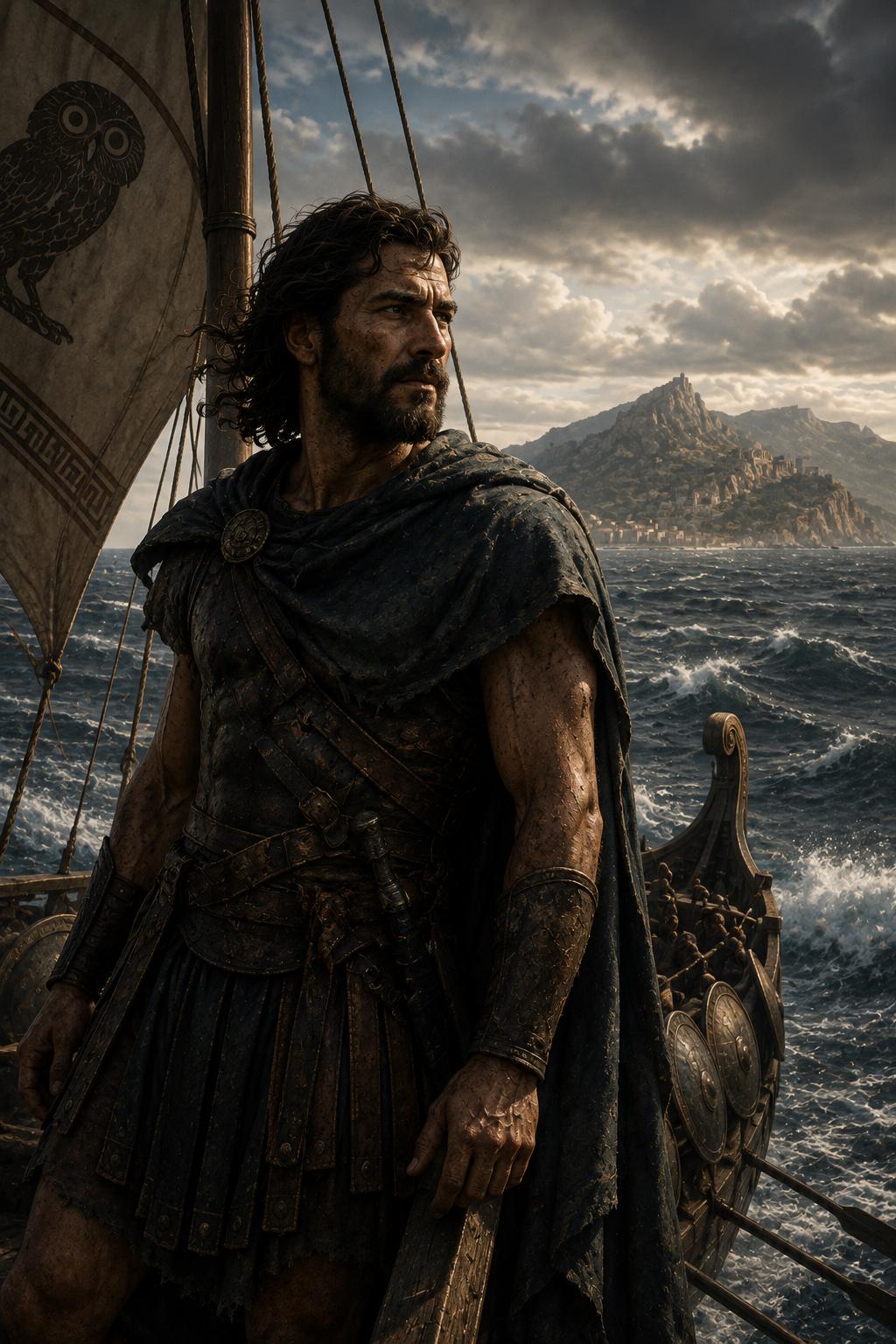
Odysseus: The Hero Who Wanted to Go Home
Among the heroes of Greek mythology, Odysseus stands apart. Achilles is remembered for unmatched ability in battle. Hector represents duty and defense of home. Heracles is defined by extraordinary strength. Odysseus survives through something different: intelligence, adaptability, patience, deception, endurance, and an unwavering desire to return home. King of Ithaca and one of the Greek leaders of the Trojan War, Odysseus spends ten additional years trying to return to his wife Penelope, his son Telemachus, and the kingdom he left behind. Homer’s Odyssey transforms that journey into one of history’s greatest stories about what it means to endure.
From the Trojan War to The Odyssey
The story of Odysseus begins before the opening of the Odyssey. He was one of the Greek leaders who sailed to Troy and fought in the Trojan War, a conflict traditionally said to have lasted ten years. Odysseus became known not simply as a warrior but as a strategist. Later tradition strongly associates him with the plan of the Trojan Horse, the deception that allowed Greek warriors to enter Troy and finally bring the war to an end. But victory at Troy does not mean the end of Odysseus’ struggle. The journey back to Ithaca becomes another ten-year ordeal. After a decade fighting to defeat an enemy, Odysseus must spend another decade fighting simply to get home.
Nostos: The Meaning of the Return Home
One of the most important ideas behind the Odyssey is the ancient Greek concept νόστος (nostos)—the return home, particularly the homecoming of a warrior after a long absence. For Odysseus, nostos means far more than reaching a geographical destination. Ithaca represents his identity, family, responsibilities, kingdom, and place in the world. Throughout his journey, he encounters opportunities to abandon that goal. Comfort, immortality, temptation, fear, exhaustion, and despair could all prevent his return. Yet Odysseus continues. The destination matters because it represents something worth enduring hardship to reach.
Intelligence as a Weapon
Odysseus is frequently described through the idea of mētis (μῆτις)—a form of cunning intelligence, cleverness, and practical wisdom. His greatest weapon is often his mind rather than his sword. The encounter with the Cyclops Polyphemus demonstrates this clearly. Trapped inside the Cyclops’ cave, Odysseus cannot simply overpower the giant. Instead, he devises a plan. He identifies himself as “Nobody,” blinds Polyphemus, and escapes by hiding beneath the Cyclops’ sheep. The episode demonstrates the quality that repeatedly saves Odysseus: when strength alone cannot solve a problem, intelligence may find another path.
The Cost of Pride
Odysseus’ intelligence does not make him immune to destructive pride. After escaping Polyphemus, he cannot resist revealing his true identity. The decision allows the Cyclops to call upon his father, Poseidon, to punish Odysseus and obstruct his journey home. It is one of the great contradictions within his character. The intelligence that saves him is accompanied by pride that creates further suffering. Like many Greek heroes, Odysseus is not presented as flawless. His strengths and weaknesses exist together. The Odyssey repeatedly suggests that surviving one challenge does not guarantee wisdom in the next.
The Sirens: Discipline Against Temptation
The Sirens present Odysseus with a different kind of danger. Their song promises irresistible knowledge and draws sailors toward destruction. Odysseus wants to hear the song but understands that desire alone cannot be trusted. He orders his crew to block their ears with wax and bind him tightly to the mast, instructing them not to release him regardless of what he demands. The episode offers a remarkably enduring lesson about discipline. Odysseus does not simply assume that willpower will overcome temptation. He recognizes his own vulnerability and creates restraints before temptation arrives. Sometimes strength means knowing when not to trust yourself.
Scylla and Charybdis: Choosing Between Bad Options
Not every challenge allows Odysseus to achieve a perfect victory. To continue his journey, he must sail between Scylla, a deadly monster, and Charybdis, a destructive whirlpool. Avoiding one danger completely means moving closer to the other. Odysseus is forced to choose a path knowing that loss is unavoidable. The episode survives in modern language through the idea of being caught “between Scylla and Charybdis”—between two dangerous alternatives. Leadership sometimes means making decisions when no option is good and accepting responsibility for the consequences.
Calypso and the Choice to Remain Mortal
Perhaps one of the most revealing parts of Odysseus’ journey occurs on the island of Calypso. She keeps him there for years and offers him something extraordinary: the possibility of immortality if he remains with her. Yet Odysseus still longs for Ithaca. The choice says something fundamental about the Odyssey. Home, identity, family, and belonging are worth more to Odysseus than an endless existence disconnected from the life he considers his own. His goal is not merely survival. It is returning to the place and people that give survival meaning.
Penelope: The Other Story of Endurance
The Odyssey is not solely a story about Odysseus enduring hardship. Penelope has her own struggle in Ithaca. For years she faces suitors who assume Odysseus is dead and pressure her to remarry. She resists through patience and intelligence, famously delaying them by promising to choose a husband after completing a burial shroud while secretly undoing her work at night. Her endurance parallels that of Odysseus. While he struggles to cross the world and return home, Penelope struggles to preserve the home to which he hopes to return. Their stories meet around a shared quality: persistence.
The Return to Ithaca
When Odysseus finally reaches Ithaca, his journey is still not finished. He returns disguised rather than immediately announcing himself. His home has been occupied by suitors consuming his wealth and competing for Penelope. Odysseus observes, waits, tests loyalties, and chooses his moment. His return therefore depends upon the same qualities that carried him across the sea: patience, intelligence, adaptability, and control. The warrior who left Ithaca two decades earlier returns changed by war, loss, temptation, failure, and experience.
What Odysseus Teaches About Endurance
Odysseus offers a different model of strength from the nearly unstoppable warrior. He suffers setbacks. He makes mistakes. He loses ships and companions. He is stranded, tempted, threatened, deceived, and repeatedly pushed away from his destination. Yet he continues adapting. His strength is not that nothing can knock him off course. His strength is that he repeatedly finds a way to continue after being knocked off course. That distinction may be one reason the Odyssey remains so recognizable thousands of years after it was composed.
Ancient Voices: The Journey Has a Purpose
The story of Odysseus reminds us that endurance is not simply the ability to suffer. Endurance becomes meaningful when there is something worth returning to. For Odysseus, that is Ithaca—home, family, identity, responsibility, and belonging. The monsters and gods belong to mythology, but the underlying experience remains human. Plans fail. Paths change. Temptations appear. Pride creates mistakes. Circumstances beyond our control push us away from where we intended to go.
The question is whether we continue. That enduring idea is part of the inspiration behind J.Cohea Ancient Voices—bringing the warriors, words, mythology, and philosophy of the ancient world into modern designs for those who still find meaning in the voices of the past.
The journey changes you. The destination reminds you why you began.
Explore our Greek Roman Mythology collection for designs inspired by Odysseus, The Odyssey, ancient Greek mythology, legendary heroes, perseverance, fate, and the enduring journey home.
Explore the Odysseus “I Promise to Return” design, inspired by Homer’s Odyssey, the journey home to Ithaca, and the enduring themes of perseverance, loyalty, and homecoming.