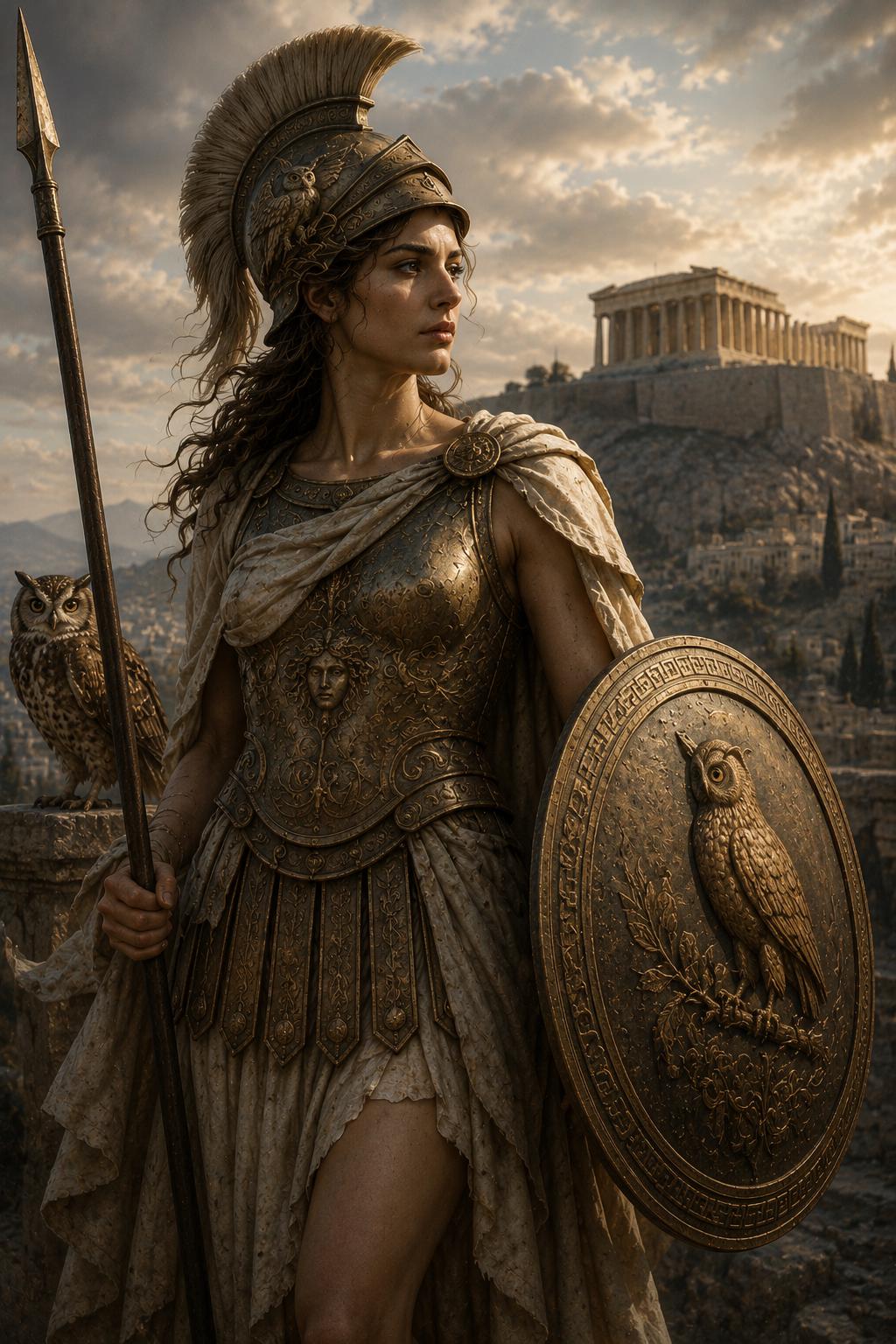
Athena: Goddess of Wisdom and Strategic Warfare
Among the gods and goddesses of Greek mythology, Athena represents a distinctive form of power. She is a warrior, but she is not defined primarily by violence. She represents wisdom, strategy, discipline, skilled craftsmanship, and the intelligent application of strength. Athena's influence extends through some of the most important stories of ancient Greece. She advises heroes, participates in the Trojan War, protects cities, and plays a central role in the journey of Odysseus. Her character reflects an enduring idea: strength becomes more effective when guided by thought. For the ancient Greeks, victory did not always belong to the strongest warrior. Sometimes it belonged to the one who understood when, where, and how to act.
The Birth of Athena
Athena's birth is one of the most unusual stories in Greek mythology. According to the tradition preserved by Hesiod, Zeus swallowed Metis, a goddess associated with wisdom and cunning intelligence, after learning of a prophecy concerning her children. Athena later emerged from Zeus, famously associated in later tradition with her appearing fully armed from his head. The symbolism became closely connected with Athena's identity. She was a warrior born not simply from physical force but from the seat of thought itself.Her mythology repeatedly combines those two qualities: intelligence and power.
Athena and the City of Athens
Athena became the patron goddess of Athens, one of the most influential cities of the ancient Greek world. According to mythology, Athena and Poseidon competed for patronage of the city. Poseidon produced a dramatic gift associated with his power, while Athena offered the olive tree. The Athenians ultimately favored Athena's gift.The olive tree provided food, oil, wood, and economic value. Symbolically, the story presents an interesting contrast. Poseidon demonstrates raw power. Athena provides something useful, sustainable, and beneficial to civilization. The city's most famous temple, the Parthenon, was dedicated to Athena. Rising above Athens on the Acropolis, it became one of the enduring symbols of ancient Greek civilization.
Athena and Ares: Two Faces of War
Greek mythology provides two very different divine representations of warfare. Ares embodies the violent, chaotic, and brutal dimensions of battle. Athena represents warfare approached through strategy, discipline, planning, and judgment. Both possess power, but they represent different ways of using it. Athena's warrior identity therefore carries an important distinction. She does not reject force. She understands when force is necessary and how it should be applied. This difference helps explain why Athena could simultaneously represent both wisdom and war. To the Greeks, those concepts were not necessarily contradictory. Effective leadership in battle required intelligence, preparation, restraint, and the ability to anticipate an opponent. The sword mattered.But so did the mind directing it.
Athena and the Trojan War
Athena plays an important role in the mythology surrounding the Trojan War. The conflict's legendary origins include the Judgment of Paris, in which Paris of Troy was asked to judge which of three goddesses—Hera, Athena, or Aphrodite—was the most beautiful.Each offered him a reward. Athena offered ability and success in war, while Aphrodite promised him the most beautiful woman in the world. Paris chose Aphrodite, setting into motion events that ultimately led toward the war at Troy. Athena subsequently supported the Greek side of the conflict. Throughout Homer's Iliad, she intervenes in the affairs of warriors, advises favored Greeks, and influences events on the battlefield. Yet her involvement again demonstrates her characteristic approach to conflict: she frequently guides decisions rather than relying simply upon overwhelming force.
Athena and Odysseus
Few Greek heroes are as naturally connected with Athena as Odysseus. Their relationship makes sense. Odysseus survives not because he is the strongest warrior in Greek mythology but because he is adaptable, patient, strategic, and exceptionally clever. These are qualities Athena understands.In Homer's Odyssey, Athena repeatedly assists Odysseus and his son Telemachus. She offers guidance, disguises Odysseus, influences circumstances around him, and helps prepare the conditions for his eventual restoration in Ithaca. Athena does not simply remove every obstacle from his path. Odysseus must still think, endure, choose, and act.Their relationship reinforces one of the central ideas surrounding Athena: wisdom is not passive knowledge. Wisdom must be applied.
Athena and the Meaning of Wisdom
Modern descriptions frequently call Athena simply the "goddess of wisdom," but the concept is richer than possessing knowledge.Athena's wisdom is practical. It appears in strategy, judgment, craftsmanship, planning, leadership, and the ability to understand circumstances before acting. This is one reason Athena remains such a compelling figure. She represents an alternative to the idea that strength is measured only th, a protective object associated with Zeus and Athena. The head of Medusa—the Gorgoneion—also became closely connected with Athena's protective imagery.These symbols combine the different dimensions of the goddess: understand the situation in front of them. Athena represents the intelligence that should precede action.
The Owl and the Symbols of Athena
Several symbols became strongly associated with Athena. Perhaps the most recognizable is the owl, particularly the little owl associated with Athens. Over time, the owl became an enduring symbol of wisdom and perception. Athena is also associated with the olive tree, reflecting her connection with Athens and the legendary contest with Poseidon. Her warrior imagery frequently includes a helmet, spear, shield, and the aegis, a protective object associated with Zeus and Athena. The head of Medusa—the Gorgoneion—also became closely connected with Athena's protective imagery. These symbols combine the different dimensions of the goddess: wisdom, protection, civilization, strategy, and war.
Athena and Medusa
The relationship between Athena and Medusa is considerably more complicated than many modern retellings suggest. Different ancient sources preserve different versions of Medusa's story. In early Greek tradition, Medusa is one of the Gorgons and the only one who is mortal. Later authors developed additional versions of her origins and transformation. Athena ultimately assists the hero Perseus in his quest to defeat Medusa, and the Gorgon's head later becomes associated with Athena's aegis or shield. This is a useful reminder when exploring Greek mythology: there is often no single universal version of a myth. Greek stories developed over centuries, changed between regions, and were retold by different poets, playwrights, artists, and later writers. The variations are part of the mythology rather than flaws within it.
Strategy Before Strength
Athena's mythology contains an idea that remains relevant far beyond ancient warfare: Think before acting. Raw strength can solve some problems. Other situations require patience, planning, observation, and restraint. The strongest response is not always the fastest response. The loudest person is not necessarily the strongest leader. And winning does not always require overpowering an opponent. Sometimes victory begins by understanding the situation better than everyone else. That is the kind of strength Athena represents.
Why Athena Still Matters
Athena remains one of the most recognizable figures from Greek mythology because the qualities she represents have never become obsolete.Wisdom matters. Strategy matters. Courage matters.Discipline matters. The ability to apply strength intelligently matters. Her mythology rejects the false choice between being thoughtful and being strong. Athena is both. That combination has allowed her image to survive for thousands of years—from ancient temples, pottery, coins, and sculpture to modern literature, art, film, and design. The civilization that worshiped Athena belongs to antiquity. The principles represented by her stories do not.
Ancient Voices: Wisdom Before Action
Athena reminds us that strength without direction can become wasted force. The warrior who understands only aggression is incomplete. The leader who acts without understanding creates unnecessary risk. The person who possesses knowledge but never applies it accomplishes little. Wisdom becomes powerful when translated into action.
That principle is part of the inspiration behind J.Cohea Ancient Voices—bringing forward the mythology, warriors, language, and ideas of earlier civilizations through modern designs rooted in the stories that survived them. Athena's temples may belong to the ancient world, but the principle behind her story remains remarkably modern: Think clearly. Choose deliberately. Act decisively.
Explore our Greek Roman Mythology collection for designs inspired by Athena, the gods and goddesses of ancient Greece, Greek mythology, wisdom, strategy, courage, and the enduring symbols of the classical world.