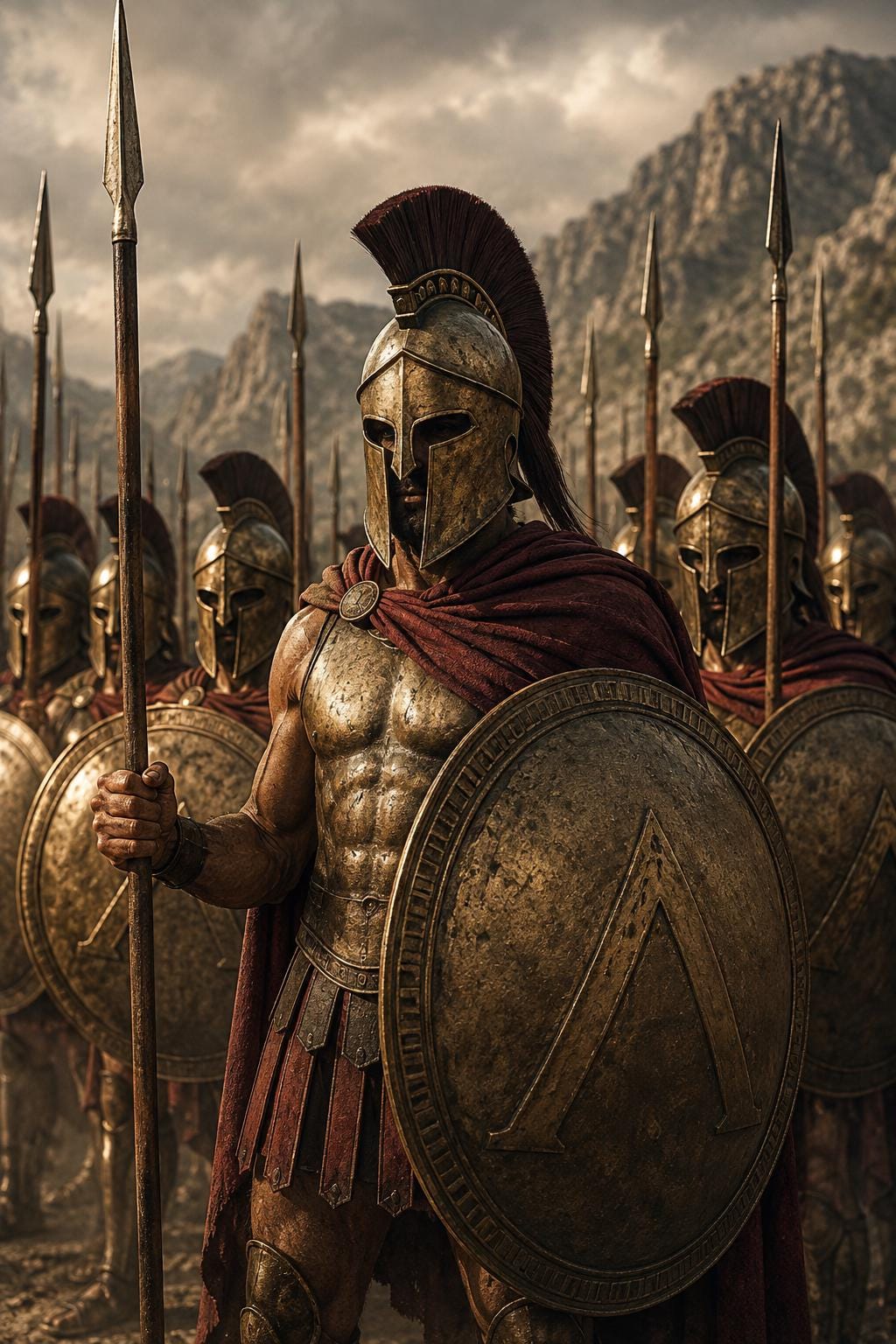
Sparta: More Than a Warrior Legend
Few societies from the ancient world have developed a reputation as powerful as Sparta. The name itself has become shorthand for toughness, discipline, austerity, and military excellence. Popular culture often reduces the Spartans to fearless warriors carrying shields and spears into impossible battles. The historical reality was considerably more complex. Sparta was a highly structured society whose military reputation developed from an entire social system built around discipline, preparation, conformity, and service to the state. For Spartan citizens, military ability was not simply an occupation. It was connected to identity, citizenship, responsibility, and belonging. Understanding Sparta therefore requires looking beyond the battlefield. The qualities that made Spartan warriors famous were cultivated long before they ever faced an enemy.
Courage: Standing When Fear Is Present
Spartan courage should not be confused with the absence of fear. Courage has meaning precisely because danger exists. The Spartan ideal emphasized maintaining one's position, controlling fear, and fulfilling one's responsibility alongside fellow warriors. In the close formation of the Greek hoplite phalanx, individual courage mattered, but so did trust. A warrior's shield protected more than himself. Depending on formation and circumstances, it also contributed to the protection of the men fighting beside him. That creates an important distinction between courage and recklessness. The objective was not simply to demonstrate personal bravery. It was to remain dependable when others were depending on you.
Discipline: Built Before the Battle
Spartan military effectiveness did not suddenly appear when battle began. It was the product of preparation. Spartan male citizens underwent the agōgē, the state-supervised system of education and training associated with the development of future citizens and soldiers. Young Spartans were conditioned toward physical endurance, obedience, competition, group identity, and resilience. The system was demanding by design. Spartan society attempted to make hardship familiar before the battlefield made hardship unavoidable. This reflects one of the most enduring principles associated with disciplined organizations: performance under pressure is usually determined by preparation before the pressure arrives. Training creates habits. Habits create consistency. And consistency matters most when circumstances become difficult.
Duty to Something Larger Than Yourself
Spartan society placed enormous emphasis on the collective. The individual warrior mattered, but he fought as part of a formation, served within a military system, and carried obligations to the Spartan state. This helps explain why Spartan culture became so closely associated with duty. A warrior who abandoned his position could endanger others. A soldier who failed to maintain discipline could weaken the formation. Individual decisions had collective consequences. The Spartan ideal therefore demanded more than personal toughness. It demanded reliability. Duty meant fulfilling your responsibility even when doing so was uncomfortable, dangerous, or personally costly.
The Shield and the Spartan Phalanx
The shield became one of the most recognizable symbols of the Greek hoplite warrior. The large round aspis provided substantial protection and was fundamental to hoplite warfare. In formation, shields, spears, armor, discipline, and coordinated movement helped transform individual soldiers into a collective fighting force. This is one reason the shield carries such powerful symbolism when discussing Spartan values. A spear is primarily an offensive weapon. A shield protects. And within a formation, protection is not entirely individual. The symbolism fits the Spartan ideal remarkably well: strength was not simply the ability to defeat an enemy. Strength also meant remaining in position so that the people beside you could depend upon you.
Thermopylae and the 300 Spartans
No event is more closely associated with Spartan courage than the Battle of Thermopylae in 480 BCE. King Leonidas led a Greek force attempting to delay the much larger Persian army of Xerxes during the second Persian invasion of Greece. His famous contingent included 300 Spartan citizens, but they were not alone. Thousands of other Greeks participated in the defense of Thermopylae, including contingents from Thespiae, Thebes, and other Greek communities. This distinction matters. The historical battle is impressive without removing the other Greeks who fought there. After the Persian forces discovered a route around the Greek defensive position, Leonidas remained with a smaller force that included his Spartans and other Greek defenders. Their final resistance became one of antiquity's most famous examples of fighting despite overwhelming odds. Thermopylae was ultimately a Persian victory. But military defeat became cultural immortality.
Molon Labe: “Come and Take Them”
One of the most famous phrases associated with Sparta is Μολὼν λαβέ — Molon Labe, commonly translated as “Come and take them.” According to the ancient historian Plutarch, the phrase was attributed to Leonidas in response to a Persian demand that the Greeks surrender their weapons. Whether encountered as history, legend, or cultural memory, the phrase captures the image later generations formed of Spartan defiance: concise, controlled, and unwilling to surrender. Its power comes partly from its simplicity. No speech. No elaborate threat. Just refusal. That economy of language itself became associated with Sparta.
Why “Laconic” Means Brief
The region surrounding Sparta was known as Laconia, and the Spartans became famous in later tradition for short, pointed responses. That legacy survives in the English word laconic, meaning using very few words. Several famous Spartan sayings survive through ancient authors, particularly Plutarch. Some should be approached cautiously because they were recorded centuries after the events or people with whom they are associated. Nevertheless, the tradition tells us something important about how Sparta was remembered. Spartan identity became associated not merely with warriors but with controlled speech. Say what is necessary. Then act.
Endurance and the Acceptance of Hardship
Spartan culture placed unusual value on enduring discomfort. Training, communal expectations, military service, and social pressure reinforced the idea that hardship should be faced rather than avoided. Modern culture sometimes romanticizes this aspect of Sparta, but the historical system could be severe and coercive. Still, the broader principle helps explain Sparta's enduring reputation. Endurance is different from strength. Strength asks: What can you do? Endurance asks: What can you continue doing when circumstances become difficult? The Spartan ideal valued both.
The Cost Behind Spartan Society
Any serious discussion of Spartan values should acknowledge that the society supporting the Spartan warrior class had a darker side. Spartan citizens were able to devote enormous attention to military preparation partly because much of the agricultural and economic labor was performed by the helots, a subordinated and exploited population controlled by the Spartan state. The relationship between Spartans and helots was characterized by coercion and the threat of violence. This does not erase Spartan military achievement, but it prevents us from turning history into mythology. Ancient societies were complicated. We can examine courage, discipline, loyalty, and duty as ideas without pretending every institution surrounding those values deserves admiration. Understanding history requires both.
Discipline Versus Motivation
One reason Spartan imagery remains popular today is that discipline has applications far beyond warfare. Motivation is temporary. Discipline is behavioral. A person may feel motivated to train, work, study, lead, or pursue a difficult objective one day and feel completely different the next. Discipline reduces dependence on that feeling. The Spartan reputation—whether examining the historical society or the legend that developed around it—centers on preparation and consistency. You prepare before the challenge. You establish standards before they are tested. You practice before performance matters. Then, when conditions deteriorate, you rely on what has already been built.
What Spartan Values Mean Today
Modern life bears little resemblance to ancient Sparta, and there is no reason to recreate Spartan society to find meaning in some of the principles associated with it. Courage can mean acting despite fear. Discipline can mean doing what needs to be done when motivation disappears. Duty can mean understanding that other people depend upon you. Endurance can mean continuing through adversity. Loyalty can mean refusing to abandon people simply because circumstances become difficult. These principles survived because they extend beyond shields, spears, and battlefields. The setting is ancient. The values are recognizable.
Ancient Voices: Hold the Line
Sparta's legacy is complicated, as the legacy of most ancient civilizations is complicated. But embedded within the stories surrounding Sparta are ideas that continue to resonate: prepare before the challenge arrives, control fear rather than pretending it does not exist, remain dependable to those beside you, and understand that strength carries responsibility. That philosophy is part of the inspiration behind J.Cohea Ancient Voices—bringing forward the warriors, words, mythology, history, and ideas of earlier civilizations through modern designs rooted in stories that still speak to us. The armor belongs to antiquity. The principle does not.
Courage. Discipline. Duty. Hold the line.
Explore our Greek Roman Mythology collection for designs inspired by ancient Sparta, Spartan warriors, Greek history and mythology, courage, discipline, duty, and the enduring warrior traditions of the ancient world.