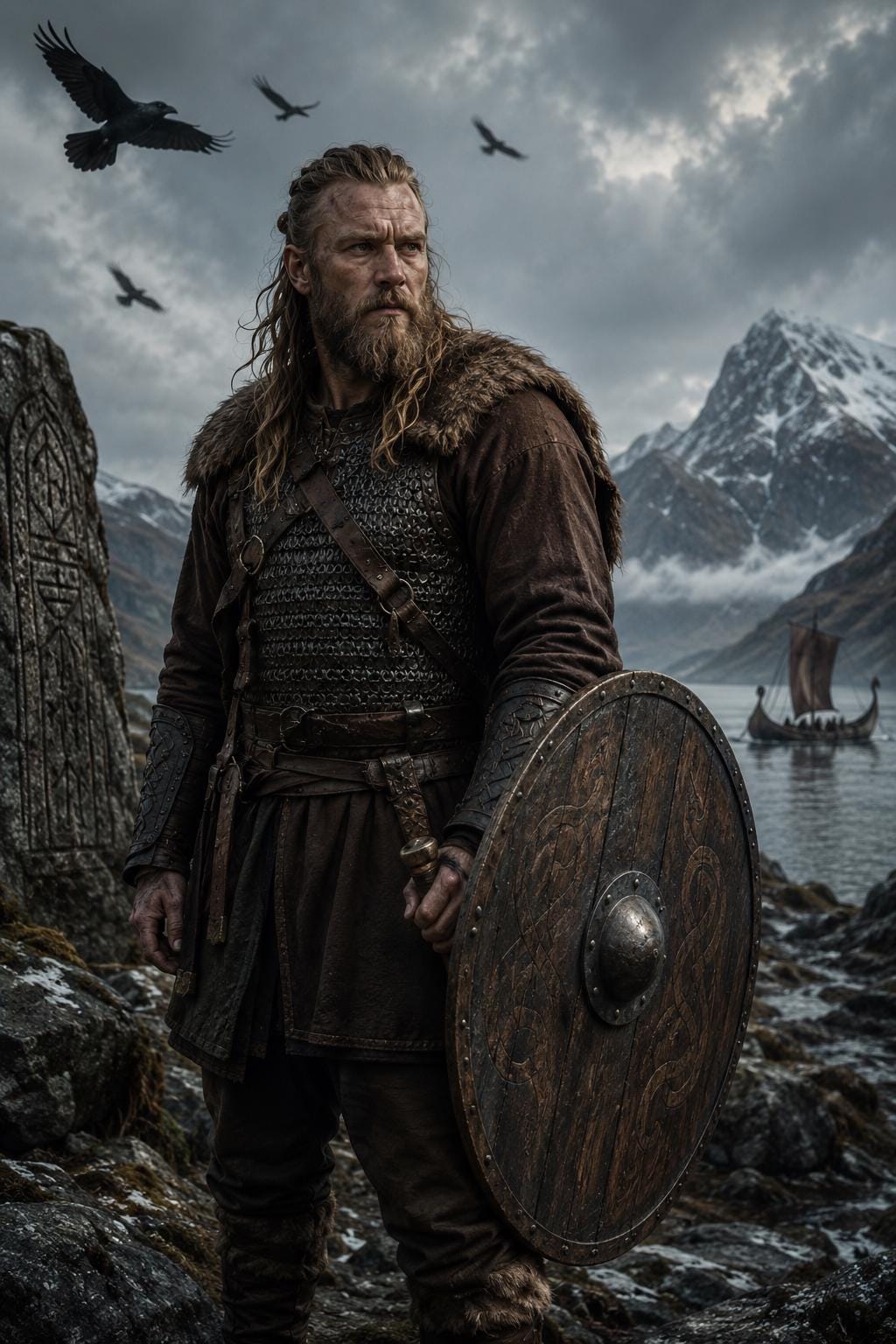
The World of Norse Mythology
Norse mythology grew from the beliefs, stories, and traditions of the peoples of ancient Scandinavia. Its world is filled with powerful gods, legendary warriors, giants, supernatural creatures, sacred symbols, and an unavoidable destiny that even the gods cannot completely escape. Unlike stories in which divine beings exist beyond danger, Norse mythology often places its gods directly in the path of struggle, sacrifice, loss, and death. Much of what survives today comes from medieval Icelandic sources such as the Poetic Edda and Prose Edda, which preserved stories that had circulated through oral tradition for generations. These tales describe a universe connected by Yggdrasil, the great world tree, and populated by realms including Asgard, Midgard, and Jötunheim. At the center are enduring ideas about courage, wisdom, loyalty, fate, sacrifice, and the reputation a person leaves behind.
Odin: Wisdom, War and Sacrifice
Odin is one of the most complex figures in Norse mythology. Associated with wisdom, war, poetry, magic, death, and kingship, he is not simply a god of physical strength. Odin continually searches for knowledge, even when obtaining it demands sacrifice. One famous tradition tells of Odin sacrificing an eye for wisdom at Mímir's well. Another describes him hanging upon the world tree, wounded by a spear, in his pursuit of knowledge of the runes. These stories present wisdom as something that carries a price. Odin is also closely connected with warriors who die in battle. The Valkyries choose among the fallen, and some are brought to Odin's hall, Valhalla. There the einherjar prepare for the final conflict of Ragnarök. Odin therefore represents a recurring theme within Norse mythology: knowledge of one's fate does not necessarily remove the obligation to face it.
Thor and the Power of Mjölnir
Thor is among the most recognizable gods of Norse mythology. Associated with thunder, strength, protection, and the defense of both gods and humanity, Thor frequently confronts giants and other forces threatening the established order. His famous hammer, Mjölnir, is more than a weapon. In Norse tradition, the hammer became an important symbol associated with Thor's protective power. Archaeological finds of hammer-shaped pendants demonstrate that the symbol had significance beyond the mythology preserved in written stories. Thor differs considerably from Odin. Where Odin often seeks knowledge through cunning, sacrifice, and strategy, Thor commonly confronts danger directly. Together they represent different forms of power—one rooted in knowledge and foresight, the other in strength, courage, and action.
Vikings, Warriors and Norse Culture
Norse mythology and Viking history are closely associated, but they are not the same thing. The Vikings were real people who lived during the Viking Age, while Odin, Thor, Loki, the Valkyries, and Ragnarök belong to the religious and mythological traditions of the broader Norse world. The societies of Scandinavia valued qualities such as courage, loyalty, reputation, family, and personal honor. Life could be uncertain, and survival often depended upon communities working together while confronting difficult environments, political conflict, warfare, and long-distance travel. The popular image of the fearless Viking warrior captures only part of this history. Norse society also included farmers, merchants, craftspeople, explorers, poets, political leaders, and settlers. Norse travelers crossed enormous distances, establishing trade routes and settlements stretching far beyond Scandinavia. Their world was shaped as much by exploration and commerce as by warfare.
Valkyries: Choosers of the Slain
The Valkyries occupy a distinctive place within Norse mythology. Their name is commonly understood in connection with choosing those who fall in battle. Acting in association with Odin, they determine which fallen warriors are selected for the afterlife connected with the gods. Later art and popular culture often portray Valkyries simply as female warriors, but the surviving traditions are more complex. They are supernatural figures connected with battle, death, fate, and the movement between the human world and the realm of the gods. Their association with fate is particularly important. A warrior may demonstrate courage, but courage does not necessarily guarantee survival. The Valkyries embody the idea that bravery exists alongside forces beyond individual control.
Valhalla and the Warrior Afterlife
Valhalla—Old Norse Valhöll—is Odin's great hall in Asgard. It is one of the best-known concepts associated with Norse mythology and is often described simply as a warrior paradise. The traditional story is more complicated. Those brought to Valhalla become the einherjar. They feast and prepare for Ragnarök, when they will fight alongside Odin and the gods. Valhalla is therefore not merely a reward for past courage. It is preparation for a future struggle. Not every person who died in battle was believed to go to Valhalla, and Norse traditions contained several ideas concerning the dead. Nevertheless, Valhalla became a powerful symbol of courage, sacrifice, fellowship, and readiness to face what comes next.
Ragnarök: The Fate of the Gods
Ragnarök is the great catastrophic sequence of events that brings destruction to much of the Norse mythological world. Gods and their enemies confront one another in battles that have long been foretold. Odin faces Fenrir. Thor battles Jörmungandr, the world serpent. Loki and Heimdall confront one another. What makes Ragnarök especially compelling is that the gods largely understand that catastrophe is coming. They fight anyway. Thor knows strength cannot permanently prevent fate. Odin's pursuit of wisdom does not ultimately allow him to escape what has been foretold. Courage in this tradition is therefore not based upon certainty of victory. It is demonstrated by how someone confronts an outcome that may be unavoidable. Yet Ragnarök is not simply an ending. The surviving traditions also describe renewal after destruction. The world emerges again, survivors remain, and life continues. Destruction and rebirth become parts of the same cycle.
Norse Symbols, Runes and Meaning
The visual language associated with the Norse world has endured alongside its stories. Runes are among its most recognizable elements. The runic alphabets were actual writing systems used by Germanic peoples for inscriptions, names, memorials, ownership marks, and communication. Modern culture sometimes treats every rune as an ancient mystical symbol with a single fixed spiritual meaning. Historical reality is more complicated. Runes were letters, although runic writing could also appear within religious and magical contexts. Other symbols associated with Norse history and mythology include representations of Mjölnir, ravens connected with Odin, ships, wolves, serpents, and imagery inspired by the interconnected patterns found in Scandinavian art. Understanding the history behind these symbols gives them greater meaning. They represent a culture that communicated ideas about identity, memory, protection, reputation, gods, and the forces believed to shape human life.
Why Norse Mythology Still Matters
Norse mythology survives because its central questions remain recognizable. What is courage when victory is uncertain? How much should someone sacrifice for knowledge? Can strength overcome fate? What makes a reputation survive after death? What obligations do people have to those who stand beside them? Odin searches endlessly for wisdom. Thor confronts threats directly. The Valkyries remind warriors that courage cannot guarantee survival. Valhalla prepares the fallen for another struggle. Ragnarök presents gods who know that even divine power has limits. These stories survived for centuries because beneath the supernatural imagery are very human concerns: fear, ambition, loyalty, sacrifice, mortality, resilience, and the desire for one's actions to have meaning.
Ancient Norse Voices: The Past Still Speaks
The Norse world disappeared long ago, but many of its stories continue to resonate. Odin's pursuit of wisdom reminds us that knowledge often demands sacrifice. Thor represents strength used in defense of others. The Valkyries connect courage with fate. Valhalla transforms the end of one struggle into preparation for another. Ragnarök reminds us that even destruction can be followed by renewal. These ideas help explain why Norse mythology continues to influence literature, art, film, historical study, and modern design. The helmets, ravens, runes, ships, hammers, warriors, and legendary figures are visually compelling, but their deeper appeal comes from the ideas behind them. JCohea Studio Apparel's Nordic Viking Inspired collection draws inspiration from these enduring stories, symbols, and traditions, bringing elements of Norse mythology and Viking history into modern designs for those who continue to find meaning in the ancient world.
The civilizations are ancient. The questions are timeless. The past still speaks.
Explore our Nordic Viking Inspired collection for designs inspired by Norse mythology, Odin, Thor, Valkyries, Valhalla, Ragnarök, Viking history, runes, and the legendary traditions of the Norse world.