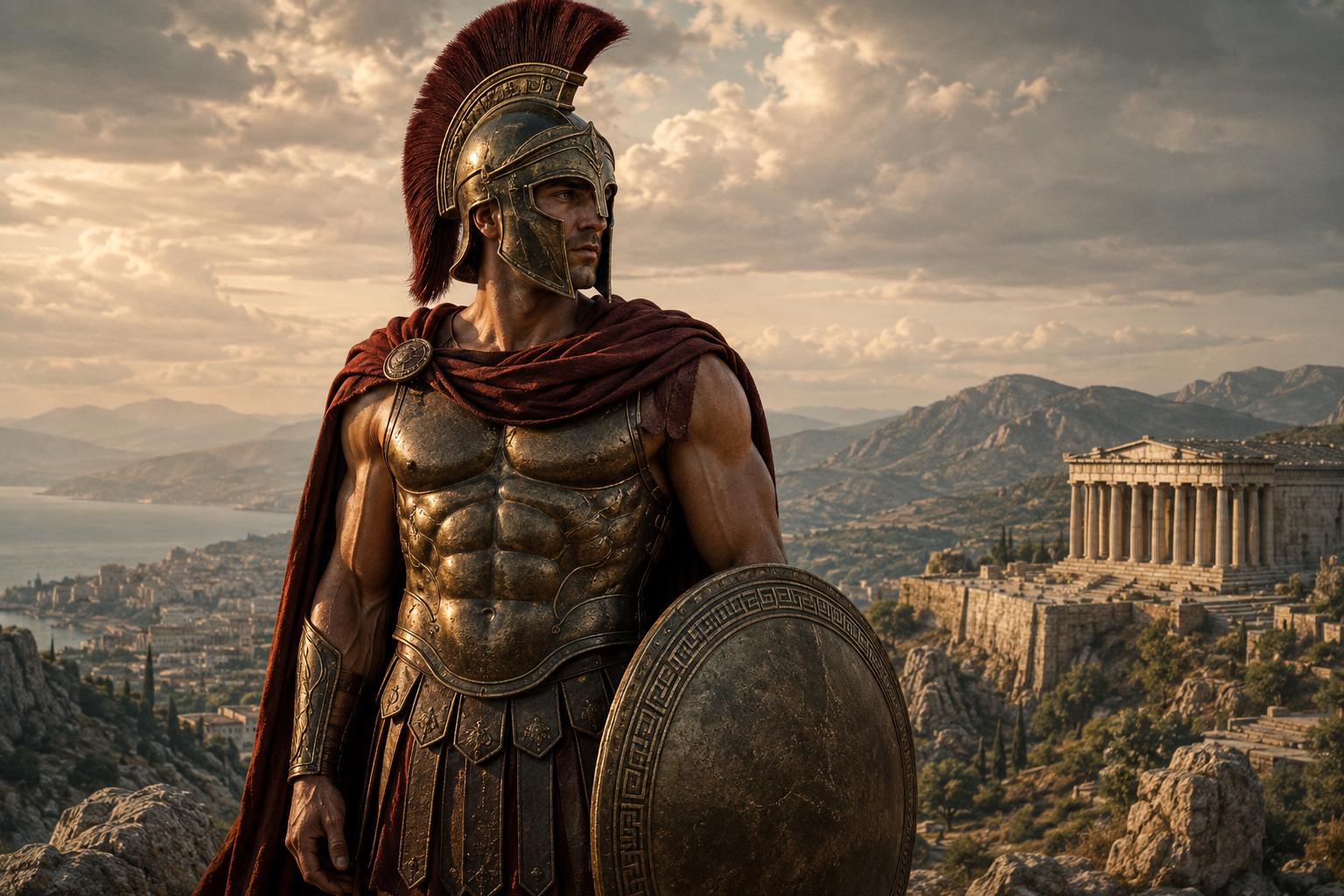
Ares: The Greek God of War, Courage, and the Brutality of Battle
Few figures in Greek mythology embody the violence and uncertainty of battle as completely as Ares. The Greek god of war represented the physical fury of combat—the clash of weapons, the rush of warriors into battle, and the destructive force unleashed when order gives way to violence. Yet Ares was more complicated than simply a divine warrior. Ancient Greek mythology often used him to explore the darker realities of warfare: courage and aggression, strength and recklessness, victory and destruction. Where other gods could represent strategy, justice, craftsmanship, or wisdom, Ares stood much closer to war itself. His stories reveal something important about the ancient Greek understanding of conflict. War could produce heroes, defend cities, and determine the fate of nations, but it could also consume those who embraced it too completely.
Who Was Ares in Greek Mythology?
Ares was one of the twelve Olympian gods and was generally described as the son of Zeus and Hera. As the god most directly associated with warfare, he represented the violent and physical dimensions of battle. His presence was imagined in the chaos of the battlefield: charging warriors, shattered formations, bloodshed, fear, anger, and the overwhelming momentum of combat. This distinguishes Ares from the modern idea of a war god who necessarily represents military leadership or disciplined strategy. Ares was not primarily the god of careful planning. He was the god of the fight. That distinction becomes particularly clear when Ares is compared with another Olympian closely associated with warfare: Athena.
Ares vs. Athena: Two Faces of War
Both Ares and Athena were associated with war, but they represented fundamentally different aspects of it. Athena embodied strategy, discipline, intelligence, preparation, and controlled military power. She represented the commander who understands when to fight, how to fight, and what must be accomplished. Ares represented something far more primal. He embodied the emotional and physical experience of combat—the fury of the warrior, the collision of armies, and the destructive violence that follows once battle begins. The contrast can be understood simply: Athena represented the strategy of war. Ares represented the fury of war. This difference helps explain why Athena frequently received greater admiration in Greek tradition. Warfare governed by intelligence and discipline could protect a city. Warfare driven purely by aggression could destroy one. The distinction also reflects a recurring principle throughout ancient Greek thought: strength without restraint can become weakness.
Ares in Homer’s Iliad
Ares appears prominently in Homeric tradition, particularly in the Iliad, where the Trojan War provides an ideal setting for a god representing battlefield violence. But Homer does not portray Ares as an invincible warrior who dominates everyone around him. Quite the opposite. Ares can be wounded, frustrated, deceived, and driven from battle. At one point, the Greek hero Diomedes wounds him with Athena's assistance. The episode demonstrates that raw violence—even divine violence—can be overcome by disciplined courage combined with intelligence. This is one of the most interesting aspects of Ares. He possesses enormous power, but power alone does not guarantee victory. For a culture fascinated by excellence, discipline, courage, and heroic achievement, that distinction mattered.
Was Ares Respected by the Ancient Greeks?
Ares was certainly powerful, but ancient Greek attitudes toward him were complicated. The Greeks understood warfare intimately. Their world contained competing city-states, military alliances, invasions, territorial disputes, and frequent armed conflict. Warriors and military service were deeply embedded within many Greek societies. But understanding the necessity of war did not mean celebrating uncontrolled violence. Ares could therefore inspire both respect and fear. He represented a force that humans might need but could never completely control. This helps distinguish him from Athena. Athena could represent warfare placed in the service of reason and civic purpose. Ares represented what happened when the violence of battle took on a momentum of its own. That made him powerful. It also made him dangerous.
The Symbols of Ares
Ancient artistic and literary traditions associated Ares with the equipment and imagery of the warrior. Common symbols connected with him include the helmet, spear, shield, armor, sword, and chariot. These objects were not merely decorative. To the ancient Greeks, they immediately communicated the identity of the warrior. The helmet protected the head while transforming the appearance of the man wearing it. The shield defended both the individual warrior and, in formation warfare, those fighting beside him. The spear extended the warrior's reach and was among the fundamental weapons of Greek warfare. Together, these objects became enduring symbols of martial identity. That imagery continues to influence how Greek warriors and gods of war are represented today.
Ares and the Warrior Archetype
Ares survives in modern culture because the qualities he represents are not confined to the ancient battlefield. He embodies aggression, courage, physical strength, confrontation, determination, and the willingness to enter conflict rather than avoid it. But Greek mythology rarely presents powerful qualities without also exploring their consequences. Courage can become recklessness. Confidence can become arrogance. Strength can become brutality. Determination can become obsession. Ares therefore represents both the attraction and danger of the warrior archetype. His mythology asks an uncomfortable question: What happens when the desire to fight becomes stronger than the reason for fighting? That question remains relevant long after the disappearance of the ancient Greek world.
Ares and Sparta
Modern audiences frequently associate Ares with Sparta because Sparta has become one of history's most recognizable warrior societies. The connection makes sense symbolically, but it should not be overstated historically. Spartan military culture emphasized discipline, endurance, obedience, cohesion, and service to the state. Those characteristics are not identical to the uncontrolled battlefield fury often represented by Ares. In fact, the distinction is revealing. The ideal Spartan warrior was not simply aggressive. He was expected to maintain his place within a larger military system. Individual courage mattered, but so did formation, discipline, training, and loyalty to those standing beside him. Ares represented the power of combat. Sparta attempted to control that power through discipline.
Ares and Mars: Were They the Same God?
When Roman culture absorbed and reinterpreted Greek mythology, Ares became closely associated with Mars, the Roman god of war. However, Ares and Mars were not originally identical figures. Mars occupied a particularly important position in Roman religion and identity. He was connected not only with warfare but also with the Roman state and the legendary origins of Rome. According to Roman tradition, Mars was the father of Romulus and Remus, the twins associated with Rome's foundation. As a result, Mars could embody disciplined military power, civic identity, and Roman expansion in ways that differed from many Greek portrayals of Ares. The comparison illustrates an important principle when studying ancient mythology: Roman gods were not simply Greek gods with Latin names. Their roles evolved within different societies with different values and traditions.
The Meaning of Ares Today
Thousands of years after ancient Greeks told stories about the Olympian gods, Ares remains immediately recognizable. Part of his endurance comes from the simplicity of what he represents. Conflict is universal. Every civilization has confronted questions about courage, violence, strength, fear, discipline, and the use of power. Ares gives those forces a human-like form. He is not merely a symbol of victory. He represents the struggle itself. That makes Ares fundamentally different from a straightforward heroic figure. His mythology does not promise that strength always wins or that courage automatically produces wisdom. Instead, Ares reminds us that power must be controlled if it is to serve a meaningful purpose.
Ares and the Enduring Voice of Ancient Greece
Greek mythology has survived because its gods were rarely simple representations of good and evil. They embodied forces that human beings recognized within themselves and within the societies they created. Athena represented wisdom and strategic action. Zeus represented authority and order. Poseidon embodied the unpredictable power of the sea. And Ares represented the violent force of conflict. His stories preserve an ancient understanding that remains surprisingly modern: strength is powerful, but strength without discipline can become destructive. That tension between courage and recklessness, discipline and rage, purpose and violence is why Ares continues to fascinate audiences today.
The weapons have changed.
The battlefields have changed.
The questions have not.
Explore our Ares and Greek Mythology collection for designs inspired by Ares, the Greek god of war, ancient Greek warriors, Olympian gods, heroic mythology, classical symbols, and the enduring legends and traditions of ancient Greece.