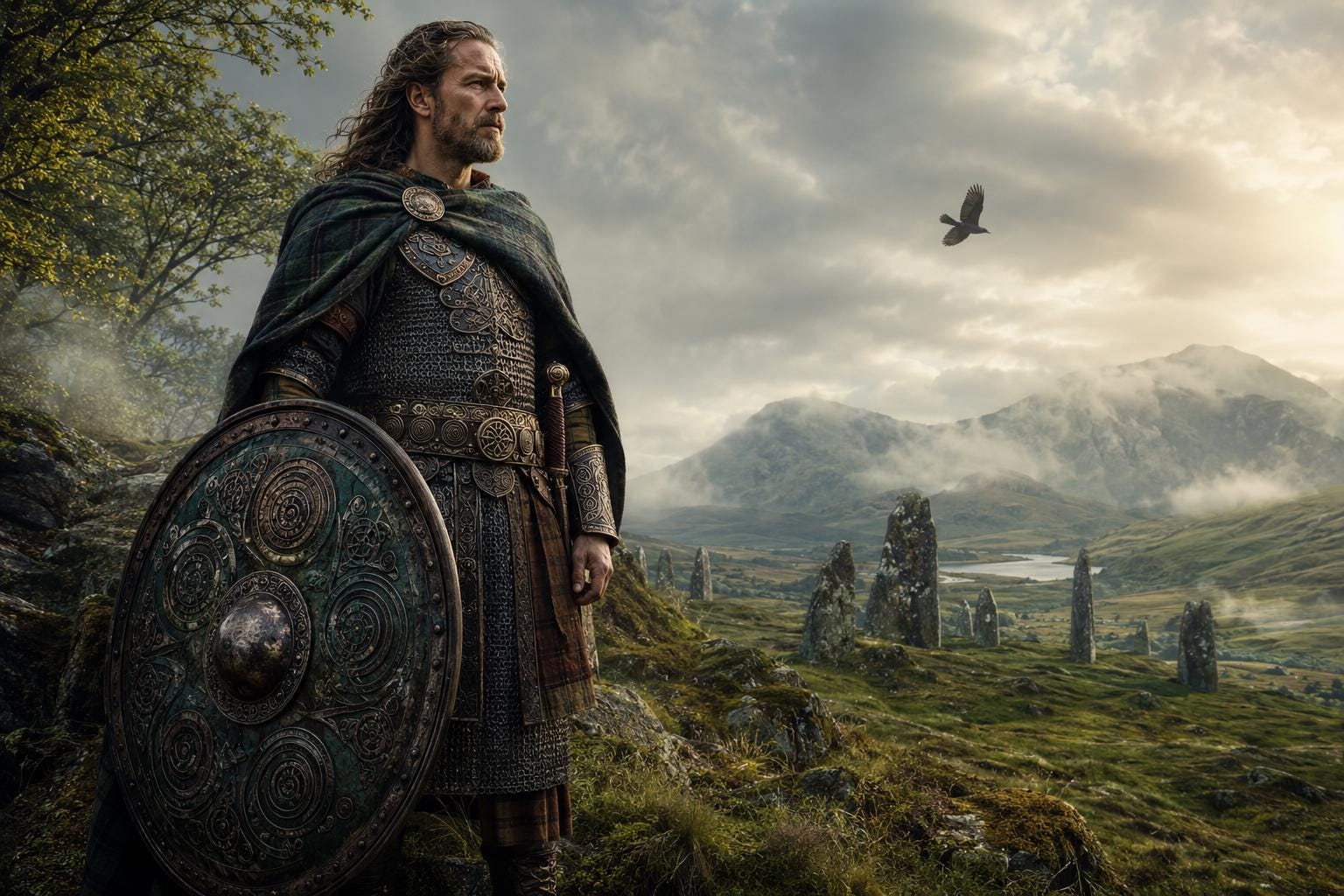
Celtic Mythology: Warriors, Gods and Symbols of the Ancient Celtic World
The ancient Celtic world has left an enduring legacy of warriors, legendary heroes, powerful supernatural figures, and intricate symbols. From the heroic stories of Ireland to the archaeological remains of Iron Age Europe, Celtic culture continues to inspire those interested in ancient history, mythology, warrior traditions, and symbolic art.
Celtic mythology was not one single, unified belief system shared identically across Europe. The peoples we now call Celts lived across different regions and centuries, from Ireland and Britain to areas of continental Europe. Much of the mythology that survives today comes from medieval Irish and Welsh literature, while archaeology and Greek and Roman accounts provide additional evidence about earlier Celtic societies.
Together, these sources reveal a world shaped by warriors, kingship, supernatural forces, fate, nature, honor, and the mysterious boundary between the human world and the Otherworld.
Who Were the Ancient Celts?
The Celts were not a single nation or empire. Celtic-speaking peoples inhabited large areas of Europe during the Iron Age, and individual communities developed their own customs, political structures, and traditions.
Two archaeological cultures are particularly important to our understanding of ancient Celtic Europe: the Hallstatt culture of the Early Iron Age and the later La Tène culture, which became known for elaborate metalwork and distinctive artistic designs.
La Tène artwork featured flowing curves, spirals, stylized animals, vegetation, and complex geometric forms. These artistic traditions helped establish the visual identity that many people still associate with ancient Celtic culture.
Celtic Warriors and the Warrior Tradition
Warriors occupied an important place in many Celtic societies. Archaeologists have discovered Celtic swords, spearheads, shields, helmets, chariots, and elaborate military equipment across Europe.
Some weapons were practical tools of warfare, while highly decorated swords, shields, scabbards, and helmets could also communicate wealth and status. Weapons have also been discovered in rivers, lakes, graves, and ritual deposits, suggesting that martial objects sometimes possessed significance beyond the battlefield.
There was no single standardized “Celtic warrior.” Celtic societies existed across many regions and centuries, and their equipment and military practices varied considerably.
Yet the warrior became one of the most enduring figures associated with the Celtic past—representing courage, reputation, loyalty, and the willingness to confront danger.
Cú Chulainn: Legendary Warrior of Ireland
One of the greatest warrior heroes of Irish mythology is Cú Chulainn, the central hero of the Ulster Cycle.
His most famous adventures appear in the Táin Bó Cúailnge, or The Cattle Raid of Cooley.
During the conflict, Cú Chulainn becomes the principal defender of Ulster and confronts enemy warriors individually. He is portrayed as extraordinarily skilled and courageous, but his story is not simply about victory.
Cú Chulainn's life is deeply connected with fate, sacrifice, loyalty, and tragedy. His heroic abilities bring glory, but they cannot ultimately allow him to escape his destiny.
This combination of extraordinary strength and unavoidable fate makes Cú Chulainn one of the most compelling warrior figures in European mythology.
The Morrígan: War, Fate and Prophecy
Another powerful figure in Irish mythology is the Morrígan, who is associated with warfare, sovereignty, prophecy, conflict, and fate.
Ravens and crows became particularly associated with her imagery, contributing to the enduring relationship between dark birds and the Celtic battlefield in modern art.
The Morrígan also appears in stories involving Cú Chulainn, where the themes of warfare and destiny become closely intertwined.
Calling her simply a “Celtic goddess of war” does not capture her full complexity. Her stories explore broader ideas involving power, kingship, territory, death, victory, and the uncertain fate of warriors.
Lugh: Master of Many Skills
Lugh is another major figure in Irish mythology and a member of the supernatural Tuatha Dé Danann.
Rather than representing strength alone, Lugh is famous for possessing mastery across many different skills. He is associated with craftsmanship, leadership, martial ability, and knowledge.
His mythology presents a different ancient ideal of greatness: true capability comes from mastery, not simply physical power.
Lugh plays an important role in the mythological conflicts of the Tuatha Dé Danann and remains one of the most significant figures of Irish tradition.
The Celtic Otherworld and Tír na nÓg
Irish mythology frequently describes a supernatural realm existing alongside the ordinary human world.
One of its most famous expressions is Tír na nÓg, commonly translated as the Land of the Young.
In the well-known story of Oisín and Niamh, Oisín travels to this extraordinary realm where aging and ordinary time appear to have little power.
When he eventually returns to Ireland, he discovers that generations have passed in his absence.
The story reflects ancient and enduring human questions about time, mortality, youth, loss, and the desire to escape death.
Celtic Knots and Ancient Symbolism
Few forms of artwork are more closely associated with Celtic heritage today than Celtic knotwork.
Elaborate interlacing patterns appear throughout early medieval Irish and British art, including manuscripts, metalwork, and carved stone monuments.
The famous Book of Kells contains some of the most sophisticated examples. Modern interpretations frequently associate endless Celtic knots with ideas such as eternity, continuity, ancestry, interconnectedness, and the cycles of life.
However, caution is necessary when assigning precise ancient meanings to individual knot designs. Many modern symbolic interpretations cannot be traced directly to documented ancient Celtic beliefs.
The historical artwork is authentic. Specific modern meanings attached to every knot are not always historically verifiable.
The Triskelion
The triskele, or triskelion, is another symbol strongly associated with Celtic and Irish visual culture.
Its threefold spiral form fits naturally with the recurring importance of groups of three in later Celtic traditions.
Yet spiral imagery in Ireland is much older than the Iron Age Celts. The famous triple-spiral carving at Newgrange predates historically Celtic cultures by thousands of years.
This makes the symbol particularly fascinating: it represents layers of Irish history extending far beyond a single civilization.
Why Celtic Mythology Still Matters
The stories and symbols associated with the Celtic world continue to resonate because their central ideas remain deeply human.
Courage. Fate. Loyalty. Sacrifice. Transformation. Mortality. Honor.
Cú Chulainn demonstrates extraordinary courage but cannot escape destiny. The Morrígan represents the uncertainty of warfare and fate. Lugh embodies mastery and capability. Stories of Tír na nÓg explore humanity's desire to transcend time and mortality.
These ancient stories survive because they address questions people still ask:
What does it mean to be courageous?
Can destiny be escaped?
What makes someone worthy of remembrance?
What remains after a person's life has ended?
The warriors, legends, mythology, and symbols of the Celtic world continue to provide inspiration because they speak to experiences far older than any single civilization.
Explore our Celtic Mythology & Heritage collection for designs inspired by Celtic warriors, ancient symbols, knotwork, legendary heroes, Irish mythology, and the enduring traditions of the Celtic world.