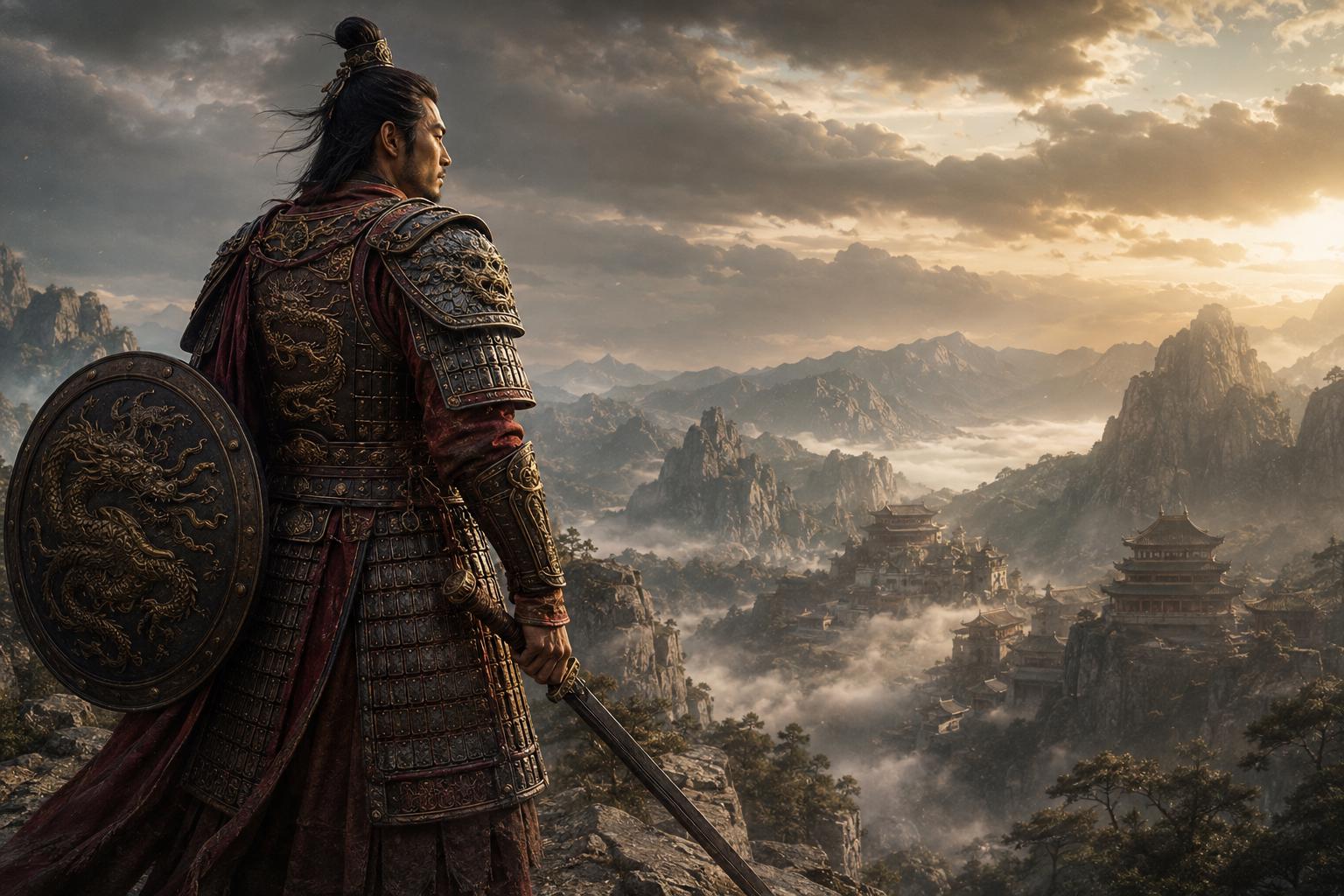
Ancient Chinese Mythology: Warriors, Gods, Dragons and Legendary Heroes
Ancient Chinese mythology is filled with powerful gods, legendary warriors, celestial creatures, heroic rebels, and stories about courage, loyalty, destiny, and the relationship between humanity and the natural world. Across centuries of Chinese history, folklore, religion, literature, and oral tradition combined to create an extraordinary mythological landscape populated by dragons, immortals, divine warriors, supernatural animals, and heroes who challenged both earthly rulers and the heavens themselves.
Unlike a single organized mythology with one definitive collection of stories, Chinese mythology developed across thousands of years. Ancient religious traditions, ancestor worship, Daoism, Buddhism, regional folklore, imperial history, and classical literature all contributed to the stories remembered today.
That long history makes Chinese mythology especially fascinating. Historical people sometimes became legendary figures. Mythological characters entered literature. Religious figures became folk heroes. Ancient symbols acquired new meanings across successive dynasties.
The result is one of the world's richest mythological traditions.
The Ancient Chinese World
Chinese civilization developed over thousands of years, producing numerous dynasties, kingdoms, philosophical traditions, religious movements, and regional cultures.
Early Chinese beliefs placed great importance on ancestors, natural forces, heaven, ritual, and the relationship between earthly rulers and cosmic order.
One important concept was Tian (天), commonly translated as “Heaven.” Heaven could represent far more than a physical sky. It became closely associated with cosmic and moral order.
This contributed to another major idea in Chinese political thought: the Mandate of Heaven, which held that a ruler's authority ultimately depended upon governing appropriately. Political catastrophe and disorder could be interpreted as evidence that a dynasty had lost Heaven's favor.
Mythology, religion, philosophy, and political authority therefore frequently overlapped in traditional Chinese culture.
Chinese Dragons: Power, Water and the Heavens
Few symbols are more immediately associated with China than the Chinese dragon, or lóng (龍 / 龙).
But the traditional Chinese dragon differs considerably from the fire-breathing monster familiar from much European mythology.
Chinese dragons were commonly associated with water, rainfall, rivers, weather, supernatural power, and imperial authority. Dragon kings appear in later traditions as rulers of bodies of water and controllers of rain.
Over time, the dragon also became strongly associated with imperial power.
Rather than simply representing something that a hero must destroy, the Chinese dragon could represent an extraordinary supernatural force worthy of respect.
This distinction is important when interpreting Chinese dragon artwork. The dragon is not merely a monster.
It can symbolize power, authority, transformation, natural forces, and cosmic energy.
Sun Wukong: The Monkey King
One of the most famous characters in Chinese literature is Sun Wukong, better known as the Monkey King.
Sun Wukong is a central character in the Ming-dynasty novel Journey to the West, one of China's great classical novels.
Born from a magical stone, Sun Wukong develops extraordinary abilities. He possesses tremendous strength, supernatural transformations, incredible speed, and his famous staff, the Ruyi Jingu Bang.
But what makes the Monkey King unforgettable is not simply his power.
It is his refusal to accept limitations.
Sun Wukong challenges authority on Earth, enters the celestial realm, causes chaos in Heaven, and eventually declares himself:
齊天大聖 — Qítiān Dàshèng
“Great Sage Equal to Heaven.”
His rebellion eventually brings him into conflict with the forces of Heaven, and his story later becomes one of discipline, transformation, and spiritual development during the journey west.
Sun Wukong therefore represents more than rebellion. His story explores the transformation of uncontrolled power into something disciplined by experience and purpose.
Guan Yu: From Warrior to Legend
Guan Yu occupies a remarkable position between history, legend, literature, and religion.
Unlike purely mythological figures, Guan Yu was a real military figure who lived during the turbulent final years of the Eastern Han dynasty.
His historical reputation grew dramatically after his death.
Stories emphasizing his loyalty, courage, righteousness, and martial ability became increasingly influential. The later novel Romance of the Three Kingdoms helped transform Guan Yu into one of the most recognizable warriors in Chinese culture.
Over centuries, Guan Yu was also deified and became widely known as Guan Gong.
His image—with his distinctive beard and guandao-style weapon—became immediately recognizable.
The values traditionally associated with Guan Yu make him particularly enduring:
Loyalty.
Honor.
Courage.
Righteousness.
His transformation from historical warrior into legendary and religious figure demonstrates how Chinese history and mythology can become intertwined.
Nezha: The Rebellious Divine Warrior
Another compelling figure is Nezha.
Nezha appears in Chinese religious and mythological traditions and became particularly famous through later literature such as Investiture of the Gods.
He is often depicted as a youthful warrior wielding supernatural weapons and moving with extraordinary speed.
Stories involving Nezha frequently revolve around conflict, family obligation, sacrifice, rebirth, and resistance against overwhelming supernatural forces.
His rebellious personality has helped make him especially enduring in modern Chinese popular culture.
Like Sun Wukong, Nezha represents a type of mythological hero who does not simply submit to the world around him.
He confronts it.
The Qilin: An Auspicious Creature
Not every powerful creature in Chinese mythology represents warfare.
The qilin (麒麟) is a legendary creature traditionally associated with auspicious events, benevolent rule, prosperity, and the appearance of exceptional individuals.
Its appearance varies considerably across Chinese artistic history. It may combine characteristics associated with deer, horses, dragons, oxen, or other animals.
The qilin is sometimes compared with the Western unicorn, but that comparison can be misleading. It belongs to a distinctly Chinese symbolic tradition with its own history and characteristics.
Its appearance was generally considered an extraordinary sign.
Where the dragon communicates supernatural power, the qilin can evoke benevolence, prosperity, wisdom, and good fortune.
The Four Symbols
One of the most visually powerful traditions for an Ancient China collection is the Four Symbols, four mythological creatures associated with the cardinal directions.
They are:
青龍 — Qīnglóng — Azure Dragon of the East
白虎 — Báihǔ — White Tiger of the West
朱雀 — Zhūquè — Vermilion Bird of the South
玄武 — Xuánwǔ — Black Tortoise of the North
These celestial creatures became associated with directions, seasons, astronomical regions, and broader cosmological ideas.
The Azure Dragon represents the East and is associated with spring.
The White Tiger represents the West and is associated with autumn.
The Vermilion Bird represents the South and is associated with summer.
The Black Tortoise—traditionally depicted with a snake—represents the North and is associated with winter.
Together they create an extraordinary visual representation of an ordered universe.
For modern artwork inspired by Chinese mythology, the Four Symbols provide something particularly valuable: authentic historical imagery that is both visually striking and connected to a much larger cosmological tradition.
The Terracotta Warriors
Not everything associated with ancient China belongs to mythology.
The famous Terracotta Army is historical.
Thousands of life-sized terracotta soldiers, horses, and other figures were created for the enormous funerary complex of Qin Shi Huang, the first emperor of a unified China.
The army was intended to accompany the emperor in the world beyond death.
This places the Terracotta Army at an extraordinary intersection of military history, imperial power, funerary belief, craftsmanship, and concepts of the afterlife.
Each warrior reminds us that ancient ideas about death could influence enormous achievements in art and engineering.
The Terracotta Warriors therefore belong naturally beside mythological subjects in a broader exploration of Ancient China—even though they should never be inaccurately described as mythological warriors.
Mythology, History and Philosophy
One of the most compelling characteristics of Chinese tradition is how frequently mythology intersects with history, religion, literature, and philosophy.
A historical warrior such as Guan Yu can become a legendary figure and eventually a deity.
A literary character such as Sun Wukong can become one of the most recognizable figures in Chinese culture.
Dragons can represent natural forces, imperial authority, and supernatural power.
Celestial animals can represent the structure of the cosmos itself.
This makes ancient Chinese culture especially rich territory for exploring the same enduring ideas found throughout many ancient civilizations:
What makes a warrior honorable?
What does loyalty require?
Can destiny be resisted?
What happens when someone challenges divine authority?
How should human beings live within a larger cosmic order?
Different civilizations answered these questions differently, but the questions themselves are remarkably familiar.
Why Ancient Chinese Mythology Still Resonates
The lasting appeal of Chinese mythology comes from more than spectacular dragons and supernatural warriors.
Its stories explore loyalty, rebellion, courage, transformation, destiny, balance, sacrifice, wisdom, and power.
Sun Wukong challenges Heaven itself.
Guan Yu becomes an enduring symbol of loyalty and righteousness.
Nezha confronts forces greater than himself.
Dragons connect humanity with rain, water, authority, and the natural world.
The Four Symbols transform animals into representations of cosmic order.
These figures and traditions survived because they express ideas that remain understandable centuries later.
They are ancient voices speaking through warriors, gods, creatures, symbols, and stories—and they remain part of one of humanity's great mythological traditions.
Explore our Ancient China collection for designs inspired by Chinese mythology, legendary warriors, dragons, ancient symbols, historical figures, and the enduring traditions of the ancient Chinese world.