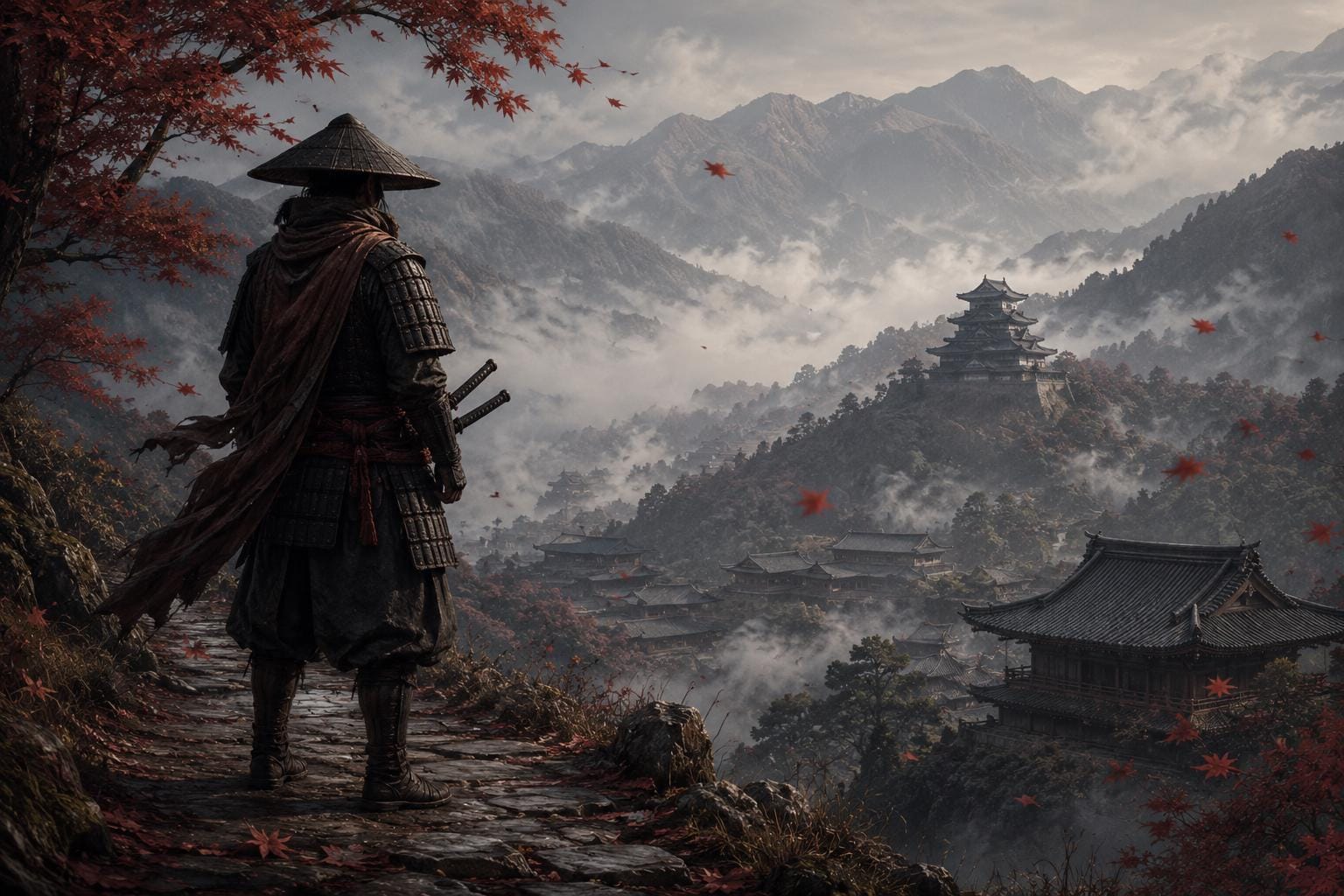
Ancient Japan: Samurai, Warriors, Honor and the Way of the Warrior
Few warrior traditions have captured the imagination of the modern world as powerfully as the samurai of Japan. Their distinctive armor, swords, discipline, and reputation for courage have made them enduring symbols of Japanese history. Yet the warrior culture of ancient and medieval Japan was far more complex than the familiar image of a lone swordsman beneath the rising sun.
Japan's warrior traditions developed over centuries of political struggle, changing military technology, competing clans, religious influences, and evolving ideas about loyalty and service. Samurai fought alongside foot soldiers, archers, cavalry, monks, and eventually large formations armed with spears and firearms. Some served powerful lords. Others lost their masters and became rōnin. Still others rose from relatively humble origins to positions of extraordinary power.
Behind these warriors was a culture shaped by ideas of courage, discipline, perseverance, loyalty, duty, impermanence, and self-mastery.
These are some of the ancient voices of Japan.
The Rise of the Samurai
The word samurai (侍) developed from a verb associated with serving or attending. Early samurai were armed retainers who served members of Japan's political and aristocratic elite.
Over time, provincial warrior families accumulated greater military and political power.
By the late twelfth century, Japan entered an era in which warrior governments would dominate much of the country's political life for centuries. The establishment of the Kamakura shogunate marked a major shift in Japanese history as military authority became increasingly institutionalized.
The samurai were not simply swordsmen.
Early warriors were particularly associated with mounted archery, while later samurai employed bows, spears, swords, and eventually firearms. Their equipment and battlefield tactics changed considerably across different periods.
The romantic image of the samurai carrying only a katana represents just one part of a much larger military tradition.
Bushidō and the Way of the Warrior
Modern discussions of the samurai frequently use the term Bushidō (武士道)—literally, the “Way of the Warrior.”
Bushidō is often presented today as though every samurai throughout Japanese history followed one fixed and formally written code. The historical reality is more complicated.
Ideas concerning loyalty, courage, honor, duty, martial skill, self-control, and proper conduct certainly existed among Japanese warriors. But what later became known collectively as Bushidō developed and changed across different historical periods.
The values emphasized by a warrior during the violent Sengoku period could differ considerably from those emphasized during the comparatively peaceful Edo period.
Nevertheless, the broader concept remains powerful.
The warrior was expected to master more than a weapon.
He had to master himself.
The Meaning of 七転八起
One Japanese expression that captures this spirit particularly well is:
七転八起
Shichiten hakki
It is commonly understood as:
“Fall seven times, rise eight.”
The expression represents perseverance, resilience, and the determination to rise again after failure or adversity.
Its significance extends far beyond warfare.
Victory does not require never falling.
It requires continuing to rise.
That idea makes 七転八起 particularly appropriate for artwork inspired by Japanese warrior traditions. A warrior walking forward after hardship can symbolize something much broader than combat: the refusal to remain defeated.
Samurai and the Sword
No object is more strongly associated with the samurai today than the Japanese sword.
The katana became particularly iconic, but Japanese warriors used several types of swords throughout history, including the tachi, which preceded the katana as an important weapon among mounted warriors.
Japanese swordsmithing developed into an extraordinarily sophisticated craft. The sword could function simultaneously as a weapon, valuable possession, family heirloom, artistic object, and symbol of warrior status.
But once again, the sword should not overshadow the rest of the samurai arsenal.
The yumi, or Japanese bow, had enormous importance.
The yari, or spear, became a dominant battlefield weapon.
The naginata, a bladed polearm, appeared in numerous periods and martial traditions.
By the sixteenth century, tanegashima matchlock firearms also transformed Japanese warfare.
The historical Japanese warrior was adaptable.
Tradition mattered—but survival demanded evolution.
The Ashigaru: Warriors from Below
The samurai were not alone on Japan's battlefields.
Ashigaru (足軽) were foot soldiers who became increasingly important as Japanese warfare grew larger and more organized.
Early ashigaru could be relatively low-status troops, but during the turbulent Sengoku period they developed into increasingly disciplined military forces. Ashigaru fought with spears, bows, and eventually matchlock firearms.
Large formations of trained foot soldiers could determine the outcome of battles.
Their story also complicates the idea that greatness in feudal Japan belonged exclusively to men born into elite warrior families.
The most extraordinary example is Toyotomi Hideyoshi.
Hideyoshi rose from relatively humble origins to become one of the three great unifiers of Japan.
His rise represents one of the most remarkable transformations in Japanese history.
Status could define where a person began.
It did not always determine where he finished.
Rōnin: The Masterless Samurai
A samurai without a lord was known as a rōnin (浪人).
The condition could arise because a lord died, was defeated, lost his territory, or dismissed his retainers.
Without a master, the warrior could lose both income and social position.
The rōnin therefore occupies an unusual place in Japanese history and popular imagination.
He could represent independence and freedom from authority—but also displacement, uncertainty, and the loss of one's established place in society.
Perhaps the most famous rōnin story is that of the Forty-Seven Rōnin, whose eighteenth-century vendetta became one of Japan's best-known narratives about loyalty, obligation, vengeance, and sacrifice.
The story endured because it presents a difficult conflict:
What does loyalty require when obedience to law conflicts with obligation to one's lord?
There is no simple warrior slogan that fully answers that question.
That complexity is precisely why the story survived.
Miyamoto Musashi and Mastery
Few individual Japanese warriors became as legendary as Miyamoto Musashi.
Musashi lived during the transition from the violent Sengoku era into the more stable Tokugawa period. He became famous as a swordsman and later wrote The Book of Five Rings.
His ideas extend beyond swordsmanship.
Musashi wrote about strategy, timing, perception, adaptability, discipline, and understanding the principles underlying conflict.
One of the most compelling lessons associated with his work is that mastery cannot be separated from continual practice.
Technique alone is insufficient.
A warrior must understand when, why, and how to act.
That principle explains why Musashi's writings continue to attract readers far removed from the battlefields of seventeenth-century Japan.
The Sengoku Period: An Age of War
The Sengoku period, often called the “Warring States” period, was one of the most turbulent eras in Japanese history.
Regional rulers known as daimyō competed for territory and political power. Alliances shifted. Castles rose across the landscape. Armies grew larger and increasingly sophisticated.
Three figures became particularly associated with the eventual reunification of Japan:
Oda Nobunaga
Toyotomi Hideyoshi
Tokugawa Ieyasu
Their careers illustrate three different approaches to power, warfare, politics, and survival.
After victory at Sekigahara in 1600, Tokugawa Ieyasu eventually established the Tokugawa shogunate. Japan entered a long period of relative political stability.
Ironically, this changed the samurai themselves.
A warrior class created through warfare increasingly had to find its place in a more peaceful society.
Zen, Buddhism and the Warrior
Japanese warrior culture was also influenced by religious and philosophical traditions.
Buddhist concepts concerning impermanence were particularly relevant in a world where status, fortune, victory, and life itself could disappear suddenly.
Zen Buddhism later became strongly associated with samurai culture, although the relationship between Zen and the warrior class is sometimes exaggerated in modern popular culture.
Still, ideas involving discipline, concentration, awareness, simplicity, and acceptance of impermanence could resonate deeply within martial traditions.
The warrior confronted an unavoidable reality:
Everything changes.
Power disappears.
Victory passes.
Life ends.
The question was how to act while one's moment remained.
Japanese Mythology and the Warrior World
Ancient Japan also possessed a mythological tradition extending far beyond historical warriors.
The kami of Shinto tradition inhabited a world filled with sacred places, natural forces, divine ancestors, extraordinary creatures, and powerful stories about the origins of Japan.
Figures such as Amaterasu, the sun goddess, and Susanoo, the storm-associated deity famous for defeating the serpent Yamata no Orochi, belong to some of Japan's foundational mythological narratives.
Mythology, religion, imperial tradition, folklore, and warrior culture intersected in complex ways over Japanese history.
That gives an Ancient Japan collection enormous room to grow.
The story does not end with the samurai.
It begins there.
Why the Warriors of Ancient Japan Still Matter
The enduring fascination with Japanese warriors is not simply fascination with swords and armor.
Their history raises questions that remain relevant:
What does loyalty require?
How should someone respond to failure?
Can discipline overcome circumstance?
What happens when the world you trained for disappears?
Is honor determined by birth, reputation, or action?
Samurai, ashigaru, rōnin, daimyō, swordsmiths, monks, and legendary figures inhabited very different positions within Japanese society.
Yet their stories repeatedly return to ideas of discipline, perseverance, adaptability, courage, service, sacrifice, and mastery.
Perhaps that is why an expression such as 七転八起 — Fall seven times, rise eight still speaks so clearly.
The battlefield has changed.
The principle has not.
Explore our Ancient Japan collection for designs inspired by samurai, ashigaru, rōnin, Japanese warrior history, traditional symbols, Japanese expressions, mythology, resilience, discipline, and the enduring traditions of the warrior world.