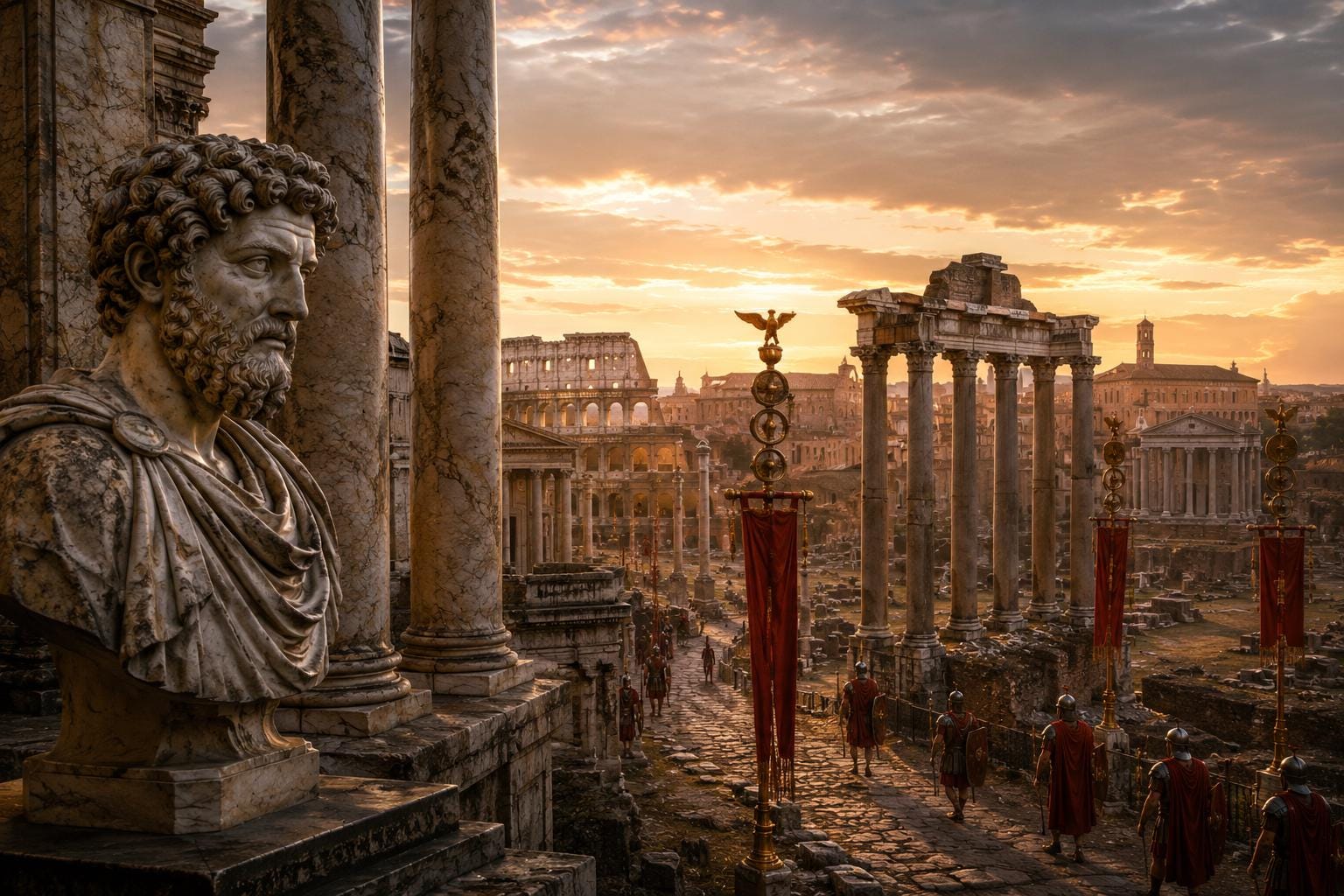
Ancient Rome: Virtue, Stoicism and the Making of an Empire
Rome began as a settlement on the Italian peninsula and grew into one of the most influential civilizations in human history. At its height, Roman power stretched from Britain to North Africa and from the Atlantic to the Middle East. Yet Rome's legacy cannot be measured only by conquered territory, roads, aqueducts, armies, or monumental architecture.
Rome also left behind a language of character.
Virtus. Disciplina. Gravitas. Pietas. Fides.
These Latin concepts expressed ideas about courage, discipline, responsibility, duty, loyalty, and personal character. They belonged to a civilization that thought deeply about what individuals owed to themselves, their families, their communities, and Rome itself.
Centuries after the empire disappeared in the West, Roman history and philosophy still ask remarkably modern questions:
What makes a person strong?
What can we actually control?
What do we owe to others?
How should we respond when circumstances turn against us?
And what remains when power, reputation, and success disappear?
These are some of the ancient voices of Rome.
From Republic to Empire
According to Roman tradition, Rome was founded in 753 BCE, although archaeology reveals a more complicated development from settlements around the hills beside the Tiber River.
Rome eventually established a republic in which political power was distributed among elected magistrates, assemblies, and the Senate. It was never a democracy in the modern sense, but the Roman Republic developed institutions and political traditions that would influence governments for centuries.
The famous abbreviation SPQR came to represent this political identity.
Senatus Populusque Romanus
“The Senate and People of Rome.”
Those four letters appeared on Roman monuments, inscriptions, standards, and public works. They represented the Roman state itself—the Senate and Roman people acting together as a political community.
But Rome was also becoming a military power.
Through warfare, alliances, colonization, and political integration, Roman influence expanded across Italy and eventually throughout the Mediterranean world.
Success brought extraordinary wealth and power.
It also brought instability.
Political competition, social conflict, military loyalty to individual commanders, and civil war gradually weakened the republican system.
From that crisis emerged the Roman Empire.
Virtus: More Than Virtue
One of the most important Roman concepts was virtus.
The English word virtue descends from it, but the Roman meaning carried associations that modern translations can obscure.
Virtus could encompass courage, excellence, strength of character, achievement, and the qualities expected of an admirable Roman citizen, particularly in public and military life. It was not simply about being morally “good.”
Virtus had to be demonstrated.
A person showed character through conduct—especially when circumstances demanded courage, endurance, judgment, or sacrifice.
For Romans, reputation mattered because actions revealed the person behind the words.
That distinction still resonates. Character is easy to claim. It is harder to demonstrate.
Disciplina: The Strength Behind the Legion
Roman military success is often represented through helmets, shields, swords, and enormous formations of legionaries.
But one of Rome's greatest weapons was less dramatic:
Disciplina.
The Latin concept encompassed training, instruction, order, and discipline. Roman soldiers trained repeatedly. They marched long distances carrying equipment, constructed fortified camps, maintained formations, followed commands, and performed the countless repetitive tasks necessary to keep an army functioning.
The Roman legion was dangerous not simply because individual soldiers were courageous. It was dangerous because thousands of individuals could function as an organized whole.
A spectacular act of bravery might win a moment.
Discipline could win a campaign.
That distinction helps explain why the Roman military became such an enduring symbol of organization and determination.
Gravitas, Pietas and Fides
Roman ideals extended beyond the battlefield.
Gravitas described seriousness, dignity, responsibility, and a sense of weight appropriate to one's obligations.
Pietas involved duty and devotion toward family, community, the gods, and Rome.
It is the source of the English word piety, although the Roman concept was broader than religious devotion alone.
Fides represented faithfulness, trust, reliability, and keeping one's commitments. Together, these concepts reveal something important about Roman ideas of character.
Strength was not simply physical. A strong person was expected to be dependable. A leader was expected to accept responsibility. A citizen belonged to something larger than himself.
Roman society frequently failed to live up to these ideals—as societies often fail to live up to their own stated values—but the ideals themselves tell us what Romans considered worthy of admiration.
Julius Caesar: Veni, Vidi, Vici
Few Roman expressions have survived as successfully as:
Veni, vidi, vici. “I came, I saw, I conquered.”
The phrase is associated with Julius Caesar following his rapid victory over Pharnaces II of Pontus at the Battle of Zela in 47 BCE. Its power comes partly from its extraordinary economy.
Three verbs.
Three actions.
No explanation.
I came. I saw. I conquered.
The phrase communicates speed, decisiveness, confidence, and complete success. More than two thousand years later, people who know almost nothing about Latin frequently recognize it.
That is part of what makes ancient language so compelling. Sometimes an entire historical attitude can survive inside three words.
The Roman Legion
The Roman legion became one of antiquity's most recognizable military institutions.
Its organization changed considerably across Rome's long history, but Roman armies became renowned for their combination of training, engineering, logistics, organization, and adaptability.
Roman soldiers did much more than fight. They built roads. They constructed camps and fortifications. They erected bridges. They moved supplies. They maintained equipment. They helped extend Roman infrastructure into newly controlled territories.
This practical approach to warfare reflects something larger about Roman civilization. Rome possessed an extraordinary ability to organize.
Military power, law, engineering, administration, taxation, transportation, and communication all contributed to the durability of Roman rule.
The empire was not maintained by the sword alone. It was maintained by systems.
Stoicism Comes to Rome
Stoicism did not originate in Rome. The philosophy began in the Greek world with Zeno of Citium around the beginning of the third century BCE.
But Roman thinkers became some of Stoicism's most famous representatives. Among them were Seneca, Epictetus, and the emperor Marcus Aurelius.
Stoicism asked a fundamental question:
How should we live in a world we cannot completely control?
The Stoic answer began by distinguishing between what depends upon us and what does not.
We cannot completely control fortune.
We cannot control other people's judgments.
We cannot guarantee success.
We cannot prevent change, loss, aging, or eventually death.
But we can work on our judgment, choices, conduct, and response to circumstances.
That distinction gave Stoicism extraordinary durability. It transformed philosophy from an abstract intellectual exercise into a practical discipline for living.
Marcus Aurelius: The Philosopher Emperor
Marcus Aurelius ruled the Roman Empire from 161 to 180 CE.
His reign was hardly peaceful. He faced warfare along Rome's frontiers, political responsibilities, personal loss, and the devastating Antonine Plague. Y
et today he is remembered as much for private reflections as imperial power. The writings now known as the Meditations were not originally composed as a book for publication.
They were personal philosophical exercises—reminders written by a man attempting to live according to principles he considered important. Again and again, Marcus returned to themes of self-control, duty, mortality, perspective, reason, and acceptance of circumstances beyond one's control.
The contrast is remarkable. One of the most powerful men in the ancient world repeatedly reminded himself that power, praise, possessions, and even life itself were temporary.
An emperor still had to govern himself. That may be the most important reason Marcus Aurelius remains relevant.
Stoicism does not promise control over the world.
It asks whether you can develop greater control over your response to it.
Memento Mori: Remember That You Will Die
Few Latin expressions have become as closely associated with modern discussions of Stoicism as:
Memento mori. “Remember that you must die.”
The idea can initially sound grim. Its purpose, however, is not necessarily pessimism. Awareness of mortality changes the value of time. If life is finite, then attention matters.
Relationships matter.
Character matters.
How we spend our limited days matters.
The ancient world encountered death far more visibly than most modern societies do, and Roman philosophical traditions repeatedly confronted mortality directly.
Death was not something philosophy could eliminate. It was something wisdom had to account for.
Remembering death was therefore also a reminder to live deliberately.
Amor Fati: Accepting What Comes
Another Latin expression frequently associated with Stoic thought today is:
Amor fati “Love of fate.”
The exact phrase itself is much later than ancient Roman Stoicism and is especially associated with the philosopher Friedrich Nietzsche, so it should not be presented as an original Roman Stoic motto.
But the idea has strong parallels with Stoic thinking. Events will occur that we would never choose. Plans fail. Fortunes change. People leave. Bodies age. Empires fall.
The Stoic challenge was not simply to tolerate reality while wishing it were different. It was to meet reality as it actually exists and determine what honorable action remains possible.
That is a considerably more demanding idea than positive thinking. It requires adaptation.
Rome and the Power of Language
Latin survived the Roman Empire.
It became the language of scholarship, theology, law, government, science, and literature across large portions of Europe for centuries. Its descendants became the Romance languages, including Italian, French, Spanish, Portuguese, and Romanian.
Latin also profoundly influenced English. That means ancient Roman voices remain hidden inside words we use every day.
But individual Latin expressions have survived as well:
Veni, vidi, vici — I came, I saw, I conquered.
Memento mori — Remember that you must die.
Carpe diem — Seize the day.
Fortuna — Fortune.
Virtus — Excellence, courage, character.
Invictus — Unconquered.
Facta non verba — Deeds, not words.
Their survival demonstrates something central to Ancient Voices: Sometimes a civilization leaves behind an entire story. Sometimes it leaves behind one word.
The Fall of Rome—and the Survival of Rome
The Western Roman Empire did not disappear in a single dramatic moment. Its political structures weakened over generations amid internal conflict, economic pressures, military challenges, migration, political fragmentation, and repeated struggles over imperial authority.
The traditional date for the fall of the Western Roman Empire is 476 CE, when the last western emperor, Romulus Augustulus, was deposed.
But Rome did not simply vanish. The Eastern Roman Empire continued for nearly another thousand years, with Constantinople at its center.
Roman law influenced later legal systems. Roman engineering remained visible across Europe. Latin survived. Roman political terminology survived.
Roman architecture inspired generations of builders. Roman philosophy continued to be read.
Even the idea of Rome became something later rulers repeatedly attempted to inherit. Empires can disappear while their ideas continue traveling.
Why Ancient Rome Still Speaks to Us
Rome fascinates us partly because it seems both distant and familiar. Its soldiers carried shields instead of rifles. Its emperors ruled without modern technology.
Its philosophers wrote by hand in a world without electricity, automobiles, or the internet.
Yet they wrestled with problems we immediately recognize.
Ambition.
Fear.
Anger.
Duty.
Loss.
Status.
Failure.
Power.
Mortality.
Purpose.
The technology changed. Human nature did not change nearly as much.
That is why a Roman emperor's private reminder can still speak to someone two thousand years later.
It is why three Latin words—Veni, vidi, vici—remain instantly recognizable.
It is why concepts such as virtus and disciplina continue to carry weight.
And it is why Rome belongs naturally within Ancient Voices.
The value of studying Rome isn't merely discovering what Romans conquered.
It is discovering what survived them.
Wear the Story
The JCohea Ancient Voices Roman collection draws inspiration from Roman history, Latin language, legionary culture, classical symbolism, philosophy, and enduring ideas of courage, discipline, duty, resilience, and character.
From the decisive confidence of Veni, Vidi, Vici to the reflections of Marcus Aurelius, these designs are intended to carry more than an image. They carry a story.
Ancient Words.
Legendary Stories.
Timeless Ideas.
JCohea Ancient Voices — Wear the Story.