Ancient Egypt: Gods, Pharaohs, Symbols and the Journey Beyond
Few civilizations have left behind imagery as immediately recognizable as Ancient Egypt.
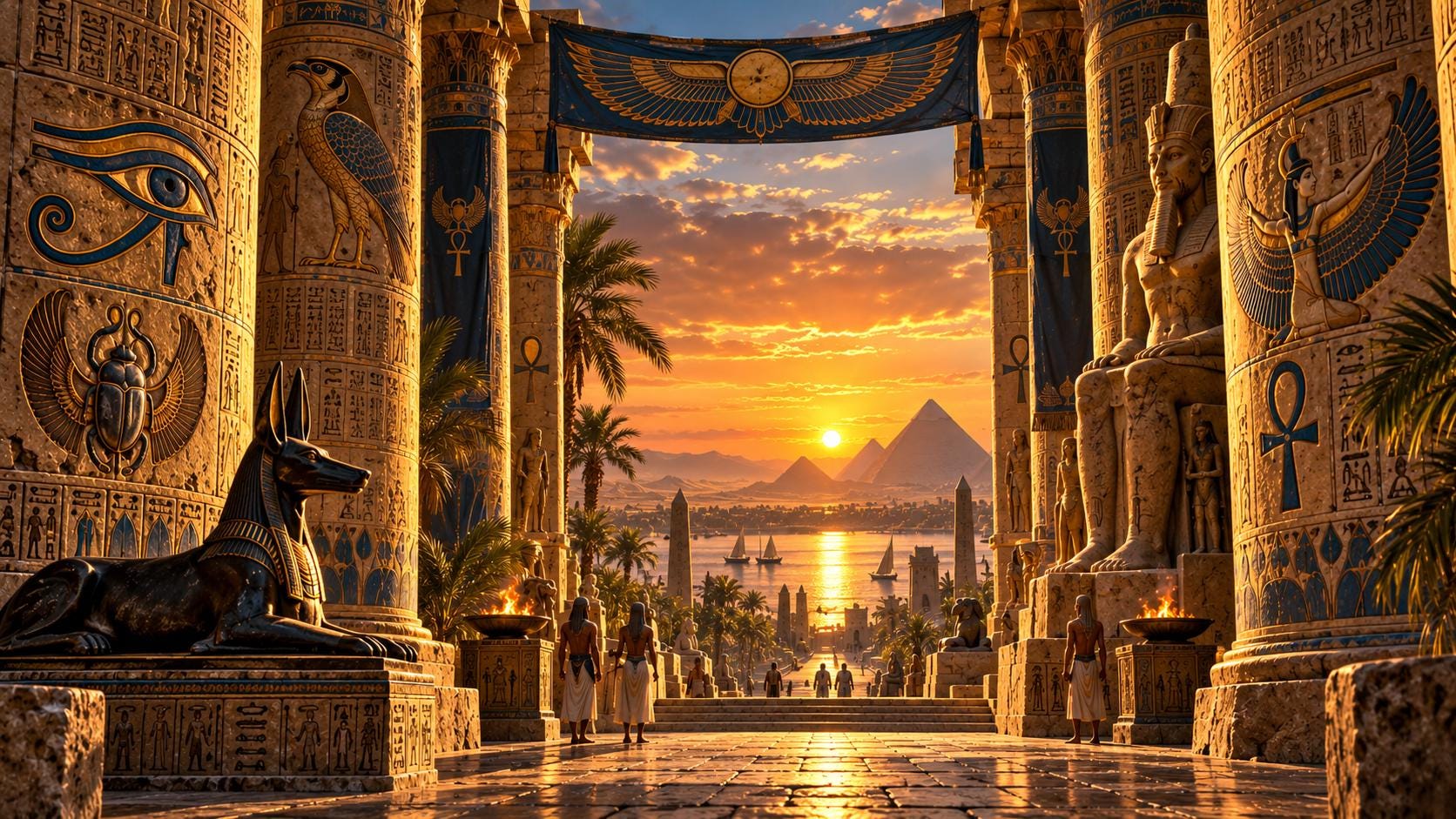
The pyramids rising from the desert, monumental temples along the Nile, hieroglyphs carved into stone, golden burial objects, powerful pharaohs, sacred animals, and gods with human and animal forms have fascinated people for thousands of years.
But Egyptian civilization was far more than its monuments.
Behind those images existed a complex world of religion, kingship, mythology, family, agriculture, astronomy, writing, art, and ideas about life and death. Ancient Egyptians sought to understand the forces that brought order to the universe and the uncertainty that threatened it.
At the center of that worldview was an enduring idea:
Order must be maintained against chaos.
That principle shaped Egyptian religion, government, morality, and even beliefs about what happened after death.
To understand the symbols of Ancient Egypt, we first have to understand the world that created them.
The Nile: The River That Made Egypt Possible
Ancient Egyptian civilization developed around the Nile River, one of the world's great waterways.
Beyond the Nile Valley stretched vast desert. Along the river, however, annual flooding historically deposited fertile soil that supported agriculture and allowed communities to flourish.
The Nile provided water, food, transportation, and a natural route connecting settlements throughout Egypt.
Its importance was so fundamental that Egyptian geography itself reflected the river.
Upper Egypt was located to the south, upriver toward the Nile's source.
Lower Egypt was located to the north, where the river spreads into the Nile Delta before reaching the Mediterranean.
Around 3100 BCE, these regions became politically unified under early Egyptian kings, beginning the long history of dynastic Egypt.
For approximately three thousand years, kingdoms rose and declined, dynasties changed, foreign powers arrived, temples expanded, and religious traditions evolved.
Yet the Nile remained.
Its recurring rhythms helped shape an Egyptian understanding of the world as a place of cycles, renewal, death, and rebirth.
The Pharaoh: Between Humanity and the Gods
The pharaoh was far more than a political ruler.
Egyptian kingship possessed a sacred dimension.
The ruler was responsible for protecting Egypt, maintaining temples, honoring the gods, defending the kingdom, and preserving the proper order of the world.
That order was expressed through one of the most important concepts in Egyptian civilization:
Ma'at.
Ma'at represented truth, justice, balance, harmony, and cosmic order.
It could describe the correct organization of the universe as well as proper human behavior within it.
The pharaoh's responsibility was therefore larger than governing territory.
He was expected to uphold Ma'at against the forces of disorder and chaos.
Egyptian art reinforced this responsibility. Pharaohs were frequently depicted defeating enemies, presenting offerings to gods, or standing in idealized poses of strength and authority.
These images were not merely portraits.
They represented what Egyptian kingship was supposed to be.
Ma'at: Order Against Chaos
Ma'at was also personified as a goddess, commonly represented with an ostrich feather.
That feather became one of the most significant symbols associated with Egyptian beliefs about judgment after death.
But Ma'at mattered during life as well.
Egyptian civilization understood existence as a balance that required maintenance.
Truth mattered.
Justice mattered.
Proper relationships mattered.
Ritual mattered.
The gods, the pharaoh, and ordinary people all participated in maintaining order.
The opposite was disorder—forces capable of disrupting both society and the cosmos.
This struggle between order and chaos appears repeatedly throughout Egyptian mythology.
It is one reason Egyptian stories continue to feel surprisingly familiar.
Every civilization has wrestled with the same question:
How do we create order in an uncertain world?
Ra: The Journey of the Sun
Among the most important Egyptian deities was Ra, the god closely associated with the sun.
Every sunrise represented renewal.
Every sunset represented departure into the dangerous world of night.
Egyptian religious traditions described the sun god traveling across the heavens during the day and through the underworld at night before emerging again with the dawn.
This was not simply an explanation for daylight.
It represented a cosmic cycle.
Light. Darkness. Struggle. Renewal.
Each morning demonstrated that order had survived another encounter with chaos.
The sun therefore became one of Egypt's most powerful religious symbols, appearing in solar disks, crowns, temples, and representations of the gods.
Osiris: Death and Rebirth
Few Egyptian myths influenced ideas about death and the afterlife as profoundly as the story of Osiris.
Osiris became associated with death, resurrection, fertility, and the afterlife.
According to different versions of the mythology, Osiris was murdered by his brother Seth. His wife Isis searched for him and restored his body through divine power.
Their son Horus eventually confronted Seth.
Osiris did not simply return to his former existence. Instead, he became ruler of the realm of the dead.
The story connected several themes central to Egyptian religion:
Death does not necessarily represent an ending.
The natural world dies and renews itself.
The Nile recedes and returns.
The sun disappears and rises again.
Human beings hoped to participate in a similar transformation.
Isis: Magic, Protection and Devotion
Isis became one of the most important goddesses of Ancient Egypt.
She was associated with magic, protection, motherhood, healing, and royal authority.
In the Osiris myth, Isis is both wife and protector. She searches for Osiris, helps restore him, and protects their son Horus.
Her importance eventually extended far beyond Egypt.
During the Greek and Roman periods, worship of Isis spread throughout much of the Mediterranean world.
Her extraordinary longevity demonstrates something important about Egyptian religion.
The gods were not simply characters in ancient stories.
They represented forces, relationships, fears, hopes, and experiences people recognized in their own lives.
Horus: The Falcon and the King
Horus is among the most recognizable Egyptian gods.
Usually represented as a falcon or a falcon-headed man, Horus was closely connected with kingship, the sky, protection, and royal authority.
The living pharaoh could be associated with Horus, strengthening the connection between divine order and earthly kingship.
The conflict between Horus and Seth became one of Egyptian mythology's defining struggles.
Horus represented legitimate kingship and restored order following the murder of Osiris.
His victory therefore meant more than defeating an enemy.
It represented the restoration of balance.
The falcon itself was an ideal symbol.
Flying high above the landscape, its extraordinary vision and commanding presence naturally connected it with the heavens and royal power.
The Eye of Horus
One of Ancient Egypt's most recognizable symbols is the Eye of Horus, often called the wedjat eye.
Its mythology is connected with the struggle between Horus and Seth, during which Horus's eye was damaged and subsequently restored.
Because of this restoration, the eye became associated with concepts including:
Protection. Healing. Restoration. Wholeness.
Eye amulets were used throughout Egyptian history and appeared in funerary contexts as well as among the living.
Today the symbol is sometimes treated simply as an exotic Egyptian graphic.
Its original significance was considerably richer.
The Eye of Horus represented something that had been damaged and made whole again.
That idea has survived remarkably well across thousands of years.
Anubis: Guardian of the Dead
With his distinctive black jackal-like head, Anubis has become one of the most recognizable figures in Egyptian mythology.
Anubis was closely associated with embalming, funerary practices, cemeteries, and the protection of the dead.
His dark coloration was not necessarily intended to make him sinister.
Black could be associated with the fertile soil deposited by the Nile and therefore with fertility and regeneration as well as the appearance of a preserved body.
Anubis occupied an important place in the transition between life and the afterlife.
He was a guardian.
A guide.
A divine presence connected with preparing the dead for what came next.
This makes Anubis considerably more complex than the threatening figure often presented in modern fantasy.
The Weighing of the Heart
Among the most powerful images in Egyptian funerary belief is the weighing of the heart.
In representations of judgment after death, the heart of the deceased could be weighed against the feather associated with Ma'at.
The symbolism is extraordinary.
The heart represented the individual—the person's character and actions.
On the other side stood the symbol of truth and order.
The deceased therefore faced a judgment not simply of power or wealth, but of how life had been lived.
Anubis is frequently depicted attending the scales, while Thoth records the result.
The scene captured an idea that has appeared in civilizations throughout history:
Our actions have consequences beyond the moment in which we choose them.
Thoth: Wisdom and the Written Word
Thoth was associated with writing, wisdom, knowledge, calculation, and the moon.
He was commonly represented as an ibis-headed man or sometimes as a baboon.
Writing held extraordinary importance in Egyptian civilization.
Hieroglyphs recorded royal achievements, religious texts, offerings, names, prayers, administrative information, and stories.
For Egyptians, writing could possess power.
Preserving a person's name helped preserve memory.
Recording words could give them permanence.
This makes Thoth particularly appropriate to the idea behind Ancient Voices.
Civilizations disappear.
Buildings collapse.
Languages change.
But written words can continue speaking thousands of years after the people who created them are gone.
The Sacred Scarab
The scarab beetle became another enduring symbol of Ancient Egypt.
Its significance was connected with the Egyptian god Khepri and the rising sun.
Egyptians observed scarab beetles rolling balls across the ground and connected this behavior symbolically with the movement and rebirth of the sun.
The scarab consequently became associated with:
Renewal. Transformation. Rebirth. Protection.
Scarab amulets were produced in enormous numbers throughout Egyptian history.
Some were worn during life.
Others accompanied the dead.
The image of a small beetle became a symbol of one of Egypt's largest ideas:
Life renews itself.
The Ankh: The Symbol of Life
Few Egyptian symbols are as immediately recognizable as the ankh.
Often described as the Egyptian symbol of life, the ankh appears frequently in temple reliefs and representations of the gods.
Deities may be shown holding the symbol or presenting it toward the pharaoh.
Its exact historical origins remain debated, but its association with life is clear.
Like the scarab and the Eye of Horus, the ankh demonstrates the extraordinary visual power of Egyptian civilization.
Complex ideas could be compressed into a single recognizable form.
Life.
Protection.
Renewal.
Order.
Egypt communicated ideas through symbols designed to endure.
And endure they did.
Hieroglyphs: Voices Carved in Stone
Egyptian hieroglyphic writing developed more than five thousand years ago.
The system used hundreds of signs representing sounds, words, and concepts.
For centuries after knowledge of hieroglyphic writing was lost, the inscriptions covering Egyptian monuments could no longer be understood.
That changed dramatically following the discovery of the Rosetta Stone in 1799.
Because the stone contained versions of the same decree written in hieroglyphic, Demotic, and Greek scripts, scholars had an extraordinary tool for decipherment.
The work of researchers—particularly Jean-François Champollion—eventually opened the written world of Ancient Egypt again.
Suddenly the monuments were no longer silent.
Names could be read.
Religious texts could be studied.
Royal inscriptions could speak again.
Ancient voices had returned.
The Pyramids and the Search for Eternity
The pyramids remain Ancient Egypt's most monumental symbols.
The Great Pyramid of Giza was constructed during the reign of Pharaoh Khufu in the Old Kingdom, more than 4,500 years ago.
Its scale continues to inspire fascination.
Yet the pyramids make more sense when understood within Egyptian beliefs about kingship and the afterlife.
They were not simply monuments demonstrating engineering ability.
They belonged to enormous funerary complexes associated with the transformation and continued existence of the king after death.
Egyptian concern with death was therefore not necessarily an obsession with dying.
It was an extraordinary concern with continuing to exist.
Bodies were preserved.
Names were written.
Offerings were provided.
Images were created.
Tombs were prepared.
The dead were equipped for another journey.
The goal was continuity.
Why Ancient Egypt Still Speaks to Us
Ancient Egypt survived as a civilization for thousands of years, but even Egypt eventually changed.
Dynasties ended.
Foreign powers ruled.
Religious traditions transformed.
Languages evolved.
Temples became ruins.
And yet Ancient Egypt never completely disappeared.
Its monuments survived.
Its symbols survived.
Its writing survived long enough to be rediscovered.
And its questions survived.
What happens after death?
What makes a life just?
How can order survive chaos?
Can something broken become whole again?
What part of us remains after we are gone?
Egyptian civilization answered these questions through gods, rituals, monuments, stories, and symbols.
The answers belonged to their world.
The questions still belong to ours.
That is why the Eye of Horus remains powerful.
Why the scarab still represents renewal.
Why Anubis remains recognizable.
Why the wings of Egyptian deities still suggest protection.
Why the ankh continues to symbolize life.
And why a civilization separated from us by thousands of years can still feel strangely familiar.
Ancient Egypt left behind far more than pyramids.
It left behind a language of symbols.
And those symbols are still speaking.
Wear the Story
The JCohea Ancient Voices Ancient Egypt Collection draws inspiration from Egyptian mythology, sacred symbols, gods, pharaohs, hieroglyphs, temple art, and enduring ideas of protection, courage, balance, renewal, life, death, and rebirth.
From the watchful Eye of Horus and the protective presence of Anubis to sacred scarabs, falcons, winged imagery, and the ancient symbols carved into Egypt's temples and tombs, each design carries a connection to a civilization whose visual language has endured for millennia.
Check out our Ancient Egypt Collection and explore designs inspired by the gods, symbols, mythology, and mysteries of one of history's most fascinating civilizations.
Ancient Words. Legendary Stories. Timeless Ideas.
JCohea Ancient Voices — Wear the Story.