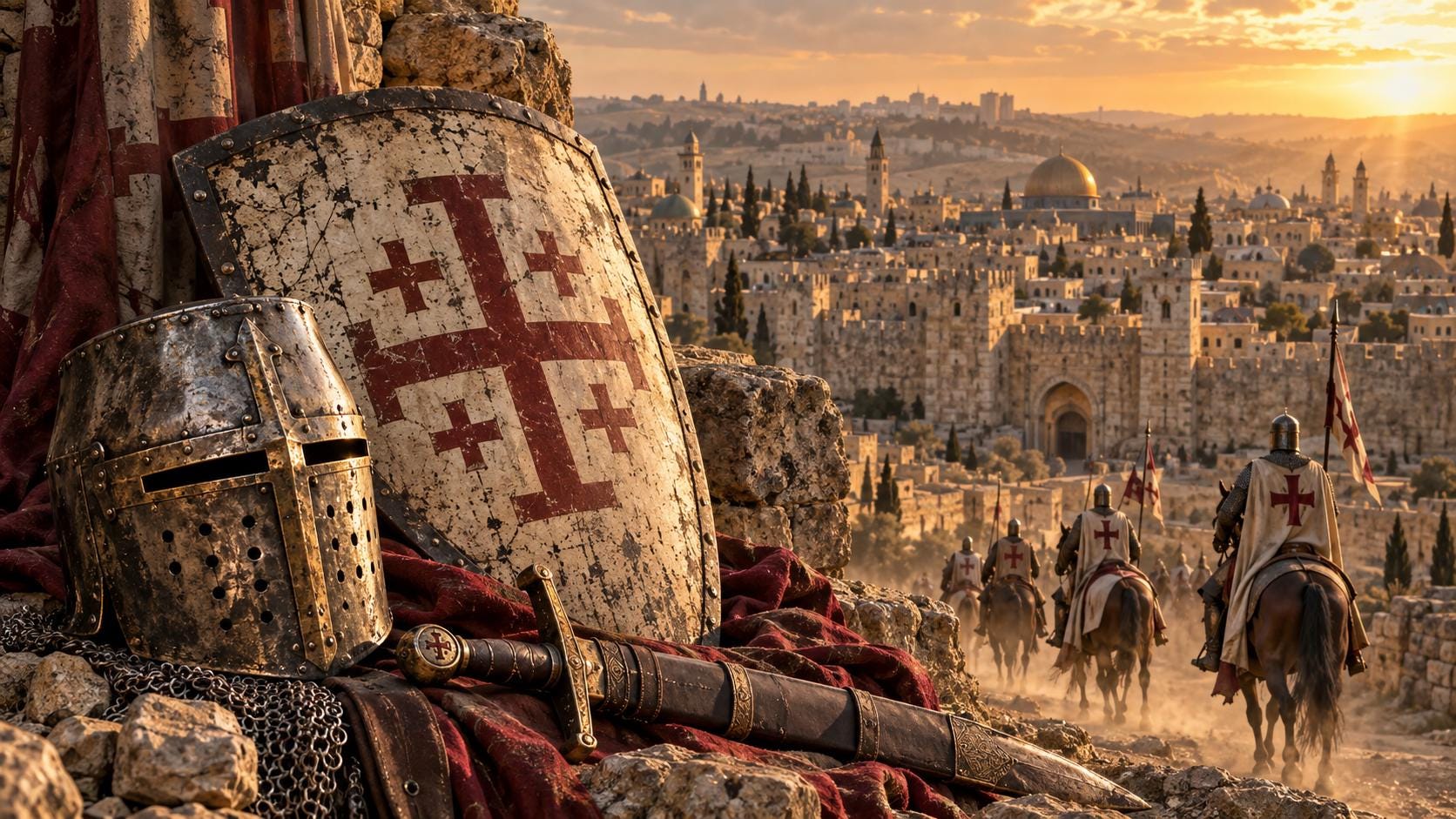
Few figures from the medieval world are as immediately recognizable as the armored knight.
A steel helmet. A sword and shield. A cross displayed across a surcoat or banner. A mounted warrior riding toward the walls of a distant city.
These images have become inseparable from the history of the Crusades and military orders such as the Knights Templar. Yet behind the familiar imagery lies a far more complicated history of religious devotion, warfare, pilgrimage, political ambition, conquest, sacrifice, cultural encounters, and violence.
The Crusades brought warriors, rulers, religious leaders, merchants, pilgrims, and ordinary people from different civilizations into direct—and often violent—contact.
They produced legends that survived long after the medieval kingdoms that created them disappeared.
And among all the warriors associated with that era, few became as legendary as the Knights Templar.
The World Before the Crusades
By the late 11th century, Europe, the Byzantine Empire, and the Islamic world were connected through warfare, diplomacy, trade, religion, and centuries of political change.
Jerusalem held profound religious importance.
For Christians, it was the city associated with the crucifixion and resurrection of Jesus.
For Jews, it was the location of the ancient Temple and one of Judaism's holiest places.
For Muslims, Jerusalem was home to the Al-Aqsa Mosque and the Dome of the Rock and was revered as the location associated with Muhammad's Night Journey.
Control of such a significant city carried enormous religious and political meaning.
Against this complicated background, Byzantine emperor Alexios I Komnenos sought military assistance from Western Christians as his empire faced pressure from the Seljuk Turks.
The response would become much larger than a conventional military alliance.
The First Crusade
In 1095, Pope Urban II addressed a gathering at the Council of Clermont in France.
He called upon Western Christians to aid fellow Christians in the East and undertake an armed expedition toward Jerusalem.
Thousands responded.
Some were experienced nobles and warriors.
Others were ordinary people.
Their motivations varied. Religious conviction was central, but participants could also be influenced by family obligations, social expectations, political interests, adventure, status, or hopes for material opportunity.
The journey was extraordinarily difficult.
Crusading armies traveled enormous distances across unfamiliar territory while dealing with hunger, disease, logistical problems, internal rivalries, and military resistance.
In 1099, Crusader forces captured Jerusalem.
The victory established several Crusader states in the eastern Mediterranean.
It also resulted in extensive killing within Jerusalem, including Muslim and Jewish inhabitants.
That violence is an essential part of the history.
The Crusades cannot accurately be reduced to a simple story of heroes and villains. They emerged from a medieval world in which religion, political power, warfare, territorial control, and identity were deeply intertwined.
Deus Vult: “God Wills It”
One of the expressions most closely associated with the First Crusade is:
Deus vult.
Commonly translated:
“God wills it.”
Medieval accounts contain variations of an acclamation associated with Pope Urban II's call for the Crusade.
For Crusaders, religious belief was not simply decoration added to warfare.
Many participants genuinely understood crusading as a sacred obligation and penitential act.
That does not make every action undertaken during the Crusades morally defensible.
It helps explain how the participants understood themselves.
This distinction matters when studying history.
Understanding what people believed is not the same as endorsing everything they did.
The words Deus Vult therefore belong to a specific historical and religious context—one that should be understood rather than separated from the complicated history surrounding it.
The Birth of the Knights Templar
The Knights Templar did not lead the First Crusade.
The order did not yet exist.
That distinction is important because modern imagery often treats “Crusader” and “Templar” as interchangeable terms.
They were not.
A Crusader was someone participating in a crusading expedition under particular religious vows and authorization.
A Templar was a member of a specific military religious order.
The organization that became the Knights Templar emerged in the early 12th century, after Jerusalem had already been captured by the First Crusade.
Its members became known as the:
Poor Fellow-Soldiers of Christ and of the Temple of Solomon.
The name reflected their association with the Temple Mount in Jerusalem, where the order established its early headquarters.
Their original mission is traditionally associated with protecting Christian pilgrims traveling through the Holy Land.
Over time, however, the Templars became something much larger.
Warrior and Monk
The Templar represented an unusual medieval combination:
Monk and warrior.
Members of the order lived under religious vows while also serving as trained fighting men.
The order developed rules governing conduct, possessions, religious observance, clothing, hierarchy, and military responsibilities.
The famous Templar imagery of a white mantle bearing a red cross eventually became one of the most recognizable symbols of the medieval military orders.
This combination of religious devotion and military discipline helped create the Templars' enduring reputation.
They were not simply knights who happened to be religious.
Their religious identity was fundamental to the organization itself.
Their lives were structured around obedience.
Discipline.
Brotherhood.
Duty.
And warfare.
The Knights Hospitaller
The Templars were not the only military religious order associated with the Crusades.
The Knights Hospitaller developed from an institution associated with caring for sick and poor pilgrims in Jerusalem.
The Hospitallers eventually became a powerful military order in their own right.
Like the Templars, they combined religious life with military responsibilities.
Another organization, the Teutonic Order, later emerged in connection with the crusading movement and became particularly important in northeastern Europe.
These orders demonstrate how medieval warfare and religion could become institutionally connected in ways that can seem unusual from a modern perspective.
The medieval knight was not always simply a professional warrior serving a king.
Sometimes he belonged to an organization that understood warfare as part of a religious vocation.
The Jerusalem Cross
One of the most distinctive symbols associated with the Crusader states is the Jerusalem Cross.
Its familiar form consists of a large central cross surrounded by four smaller crosses.
Several interpretations have been associated with the design.
One traditional interpretation sees the central cross as representing Christ and the four smaller crosses as representing the four Evangelists or the spread of Christianity toward the four corners of the world.
The symbol became particularly associated with the Kingdom of Jerusalem.
Like many historical symbols, its meaning developed through centuries of use.
Today it remains one of the clearest visual connections to the medieval Crusader era.
For Ancient Voices, this is precisely what makes historical symbols interesting.
A simple geometric form can carry centuries of history.
The Templar Seal
Another famous image associated with the Knights Templar depicts two riders sharing a single horse.
The image appeared on a seal associated with the order and has traditionally been interpreted as representing the poverty of its early members.
Like many medieval symbols, interpretations have accumulated around it over time.
What matters most is how effectively such imagery communicated identity.
Medieval society was highly visual.
Heraldry, banners, crosses, seals, shields, clothing, and religious imagery could identify allegiance long before a written explanation was necessary.
A warrior's shield could tell you who he served.
A cross could communicate religious identity.
A seal could represent an entire organization.
Symbols spoke.
The Medieval Sword
Few objects are more closely associated with knighthood than the sword.
It was a weapon, but it could also carry social and symbolic importance.
For medieval knights, swords could become associated with status, inheritance, ceremony, military service, and personal reputation.
The shape itself could even evoke Christian symbolism: a straight blade crossed by a guard naturally resembled a cross.
But the sword should not overshadow the broader reality of medieval warfare.
Knights also used lances, maces, axes, bows, crossbows, shields, and other weapons, while infantry played critical roles in medieval armies.
Siege warfare was particularly important during the Crusades.
Cities and fortifications could determine control of entire regions.
The romantic image of two knights meeting sword-to-sword represents only a tiny part of medieval warfare.
Saladin and the Return of Jerusalem
One of the most famous figures to emerge from the Crusading period was Saladin.
Known in Arabic as Salah al-Din Yusuf ibn Ayyub, Saladin became sultan of Egypt and Syria and one of the most powerful Muslim rulers of the era.
In 1187, his forces defeated a major Crusader army at the Battle of Hattin.
Jerusalem subsequently returned to Muslim control.
The loss shocked Christian Europe and contributed to the launching of the Third Crusade.
That expedition brought another legendary medieval ruler into the story:
Richard I of England.
Richard the Lionheart
Richard I—better known as Richard the Lionheart—became one of the most celebrated warrior kings of medieval Europe.
During the Third Crusade, Richard demonstrated considerable military ability and won several important victories.
Yet he never captured Jerusalem.
His conflict with Saladin became one of the defining stories of the Crusading era.
Later literature transformed both men into legendary figures, sometimes emphasizing mutual respect and chivalry.
The historical reality was more complicated.
Still, their reputations reveal something important about how history becomes legend.
Eventually, individuals stop being remembered only for what they actually did.
They become symbols of what later generations believe a warrior or ruler should represent.
Honor and the Idea of Chivalry
The word chivalry often evokes images of honorable knights defending the weak and fighting according to a strict moral code.
Historical chivalry was considerably more complicated.
It developed from the military culture of mounted warriors and gradually incorporated ideas involving courage, loyalty, reputation, religious obligation, courtly behavior, and service.
There was never one universal medieval rulebook followed by every knight.
Nor did knights consistently live according to the ideals celebrated in literature.
That difference between ideal and reality matters.
A society's ideals tell us what it admired.
Its history tells us how difficult those ideals were to achieve.
Courage could exist alongside brutality.
Faith alongside ambition.
Honor alongside betrayal.
The medieval knight was human.
That is what makes the history more interesting than the legend.
The Fall of Acre
Crusader control in the eastern Mediterranean did not last forever.
Territory was gradually lost as political circumstances changed and Muslim powers consolidated.
In 1291, the city of Acre, one of the most important remaining Crusader strongholds, fell to Mamluk forces.
Its loss effectively ended the major Crusader territorial presence on the mainland of the Holy Land.
But the military orders did not immediately disappear.
The Templars continued operating elsewhere.
Their greatest threat would eventually come not from a battlefield in the East, but from European politics.
The Fall of the Knights Templar
By the beginning of the 14th century, the Templars possessed property, financial resources, political connections, and an international organization extending across Europe.
That power also created enemies.
On Friday, October 13, 1307, King Philip IV of France ordered the arrest of Templars throughout France.
Members of the order faced accusations including heresy and other offenses.
Interrogations frequently involved torture, making many resulting confessions deeply unreliable.
Political and financial motivations played significant roles in the destruction of the order.
Under enormous pressure, Pope Clement V eventually suppressed the Knights Templar in 1312.
In 1314, the last Templar Grand Master, Jacques de Molay, was executed in Paris.
The organization was gone.
The legend was just beginning.
From History to Legend
The disappearance of the Knights Templar created fertile ground for speculation.
Over the centuries, the order became connected in popular imagination with:
Hidden treasure.
Secret knowledge.
The Holy Grail.
Lost relics.
Underground organizations.
Mysterious bloodlines.
Most of these later claims have little or no reliable historical evidence behind them.
But they demonstrate the extraordinary transformation of the Templars.
A medieval military religious order became one of history's great legends.
The historical Templars are fascinating enough without the mythology.
They rose from a small organization in Jerusalem to an international military and religious institution.
They fought in some of the defining conflicts of the Crusading era.
They accumulated extraordinary influence.
And then, within a remarkably short period, they were destroyed.
The Crusades Were More Complicated Than the Legend
Modern popular culture frequently simplifies the Crusades.
One version presents noble Christian knights defending civilization.
Another presents nothing but conquest and religious fanaticism.
Neither captures the entire historical reality.
The Crusades involved religious conviction, political ambition, pilgrimage, warfare, economics, territorial competition, personal motivations, diplomacy, cultural exchange, massacres, alliances, and shifting loyalties.
Christians sometimes fought Christians.
Muslim rulers fought other Muslim rulers.
Temporary alliances could cross religious boundaries when political interests demanded it.
Jewish communities suffered terribly during episodes of Crusading violence.
Eastern Christians could find themselves caught between competing powers.
The medieval Mediterranean was not divided neatly into two unified civilizations marching against one another.
History rarely gives us that kind of simplicity.
Understanding the Crusades means accepting the complexity.
Why the Knight Still Endures
More than seven centuries after the suppression of the Knights Templar, the medieval knight remains one of history's most powerful symbols.
Why?
Partly because the imagery is extraordinary.
Armor.
Sword.
Shield.
Horse.
Banner.
Cross.
Castle.
But imagery alone does not explain its endurance.
The knight became associated with ideas larger than the individual warrior:
Courage. Duty. Faith. Discipline. Loyalty. Sacrifice. Honor.
History shows that medieval warriors did not always embody those ideals.
But perhaps that is precisely why the ideals survived.
An ideal does not describe what people always are.
It describes what they believe they should strive to become.
The same tension appears throughout history.
Spartan discipline.
Roman virtus.
Samurai loyalty.
Norse courage.
Egyptian Ma'at.
Different civilizations created different traditions and expressed their values in different ways.
Yet across centuries and cultures, people repeatedly returned to questions of courage, duty, loyalty, mortality, and meaning.
The medieval knight represents one answer from one particular time and place.
And his voice is still being heard.
The JCohea Ancient Voices Crusaders & Templars Collection draws inspiration from medieval knights, the Crusading era, historical military orders, Latin expressions, crosses, shields, swords, armor, and the powerful symbols that emerged from the medieval world.
From the distinctive Jerusalem Cross and the history of the Knights Templar to medieval warrior imagery and expressions such as Deus Vult, each design draws from a period where faith, warfare, duty, ambition, courage, and sacrifice collided.
The purpose is not to turn complicated history into a simple legend.
It is to keep the history behind the symbols alive.
Check out our Crusaders & Templars Collection and explore designs inspired by medieval knights, military orders, historic crosses, Latin expressions, and the symbols that survived one of the most consequential periods of the medieval world.
Ancient Words. Legendary Stories. Timeless Ideas.
JCohea Ancient Voices — Wear the Story.