The Viking Longship: Exploration, Warfare and the Ship That Changed the Norse World
Few objects represent the Viking Age as powerfully as the longship.
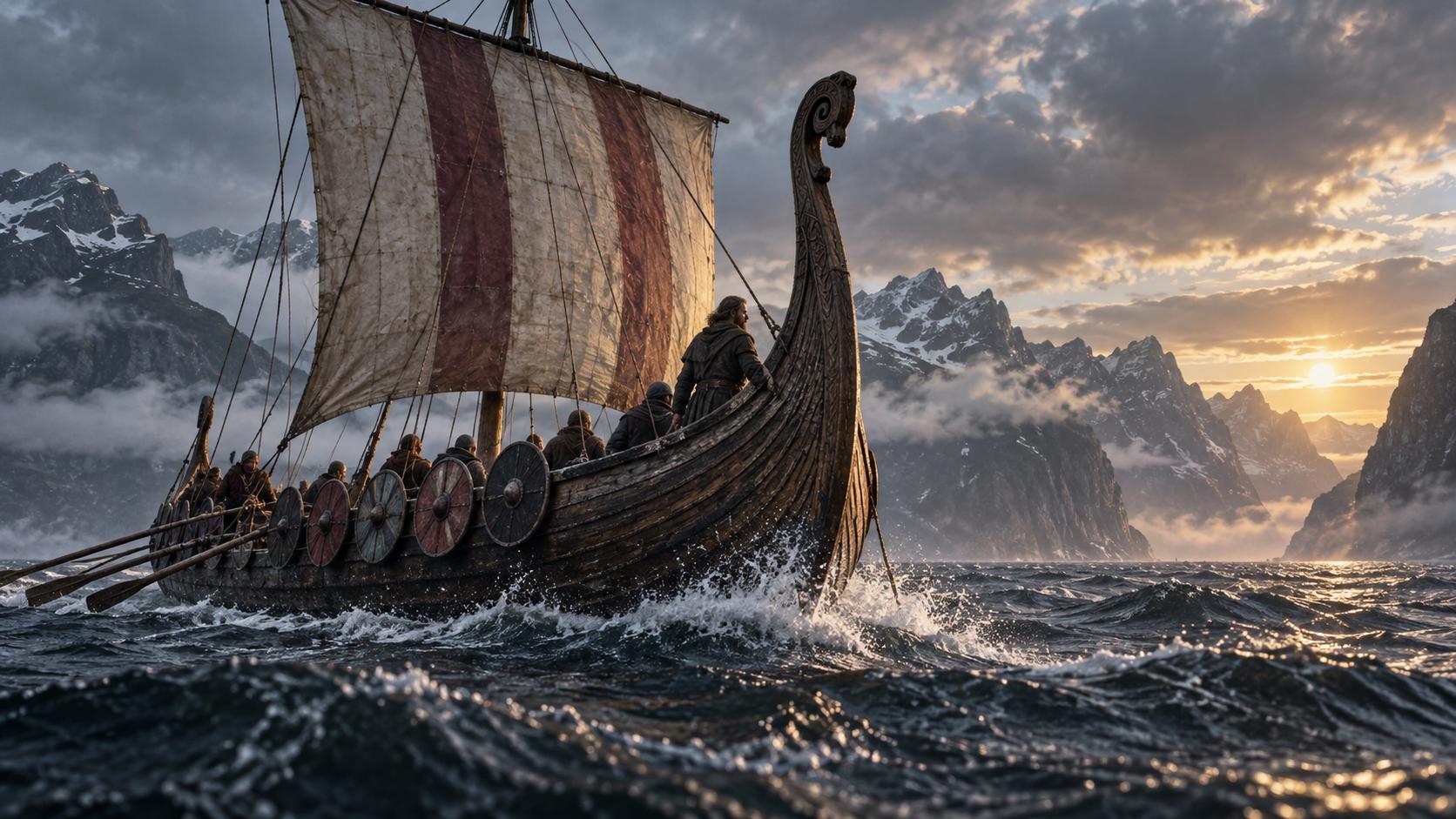
Its unmistakable silhouette—a narrow wooden hull, sweeping bow, single square sail, rows of oars, and sometimes an elaborately carved prow—has become one of the enduring symbols of the Norse world.
But the Viking ship was far more than an icon of warfare.
Ships connected Scandinavia with distant lands. They carried warriors across the North Sea, merchants along European rivers, settlers into the North Atlantic, and explorers farther west than Europeans had traveled for centuries.
They allowed the Norse to raid, trade, migrate, explore, and establish communities thousands of miles from their Scandinavian homelands.
Without the ship, there would have been no Viking Age as we understand it.
The story of the Vikings is therefore also the story of the vessels that carried them beyond the horizon.
The Sea Was a Road
Modern maps encourage us to think of seas as barriers separating countries.
For the Norse, water could function as a highway.
Scandinavia is surrounded by coastlines, fjords, islands, rivers, and waterways. Communities developed in an environment where boats were essential for fishing, transportation, trade, communication, and warfare.
By the beginning of the Viking Age in the late eighth century, Scandinavian shipbuilders had developed vessels capable of crossing open seas while also navigating shallow coastal waters and rivers.
That combination changed everything.
A Viking crew could cross the North Sea, approach a coastline, enter a river, and travel deep inland.
The same ship could then reverse course and return home.
Geography that protected communities from conventional land armies offered considerably less protection against warriors who arrived from the sea.
Not Every Viking Ship Was a Longship
Today, almost any vessel associated with the Vikings tends to be called a longship.
Historically, Norse shipbuilding was more diverse.
Different vessels were designed for different purposes.
Warships emphasized speed, maneuverability, and the ability to carry crews of fighting men.
Cargo vessels such as the knarr were broader and deeper, providing greater capacity for merchandise, livestock, provisions, and supplies.
That distinction matters.
The Norse were not only raiders.
They were also traders, settlers, farmers, craftsmen, mercenaries, explorers, and merchants.
Their ships reflected those different roles.
The sleek warship may dominate modern Viking imagery, but broader cargo vessels were equally important to the expansion of Norse communities across the North Atlantic.
Built for Speed and Flexibility
One of the defining features of Viking Age shipbuilding was clinker construction.
Instead of placing hull planks edge-to-edge, shipbuilders overlapped them and fastened them together.
This produced hulls that were relatively light and flexible while remaining strong enough to withstand difficult northern seas.
Many Viking vessels also had remarkably shallow drafts.
That allowed them to travel through waters inaccessible to deeper ships.
A crew did not always require a developed harbor.
A vessel could approach a beach, enter shallow water, or navigate rivers that provided access far into the interior.
The ships could be powered by both oars and sail.
Oars provided maneuverability when winds were unfavorable or when navigating confined waters.
The large square sail allowed crews to harness the wind during longer voyages.
The result was an extraordinarily versatile machine.
The Longship as a Weapon
A Viking longship was not a weapon in the same sense as a sword or axe.
But strategically, it could be devastating.
Its greatest advantage was mobility.
A defending ruler might know where his enemy's army was approaching by land.
Raiders arriving by sea were harder to predict.
They could appear along exposed coastlines, travel into river systems, strike vulnerable locations, and withdraw before a larger defending force could respond.
The famous attack on the monastery at Lindisfarne in 793 CE became one of the traditional markers for the beginning of the Viking Age.
The psychological effect was profound.
Places that had seemed geographically isolated were suddenly accessible.
The ship had changed the battlefield.
Rivers Opened Europe
The ability of Norse vessels to navigate rivers expanded Viking activity far beyond Europe's coastlines.
Norse groups traveled through river systems into what are now France, Germany, Eastern Europe, Ukraine, and Russia.
In Western Europe, Viking forces repeatedly used rivers to penetrate inland.
Paris itself faced Viking attacks through the Seine.
In the east, Scandinavian traders and warriors traveled along major river networks connecting the Baltic with the Black Sea and the Byzantine world.
These eastern Norse travelers are often associated with the Varangians.
Some eventually entered Byzantine service.
The famous Varangian Guard became an elite military unit associated with the Byzantine emperors and included Scandinavian warriors during portions of its history.
A Scandinavian ship could therefore be part of a journey connecting northern Europe with Constantinople.
That is an extraordinary geographic reach for the medieval world.
Viking Ships and Trade
The popular image of the Viking arriving by ship usually begins with a warrior holding a weapon.
But another Viking ship might arrive carrying:
Furs.
Amber.
Iron.
Textiles.
Walrus ivory.
Craft goods.
Silver.
Slaves.
Trade networks connected Scandinavia with Western Europe, the British Isles, the Baltic, the Byzantine Empire, and regions connected to the Islamic world.
Archaeological discoveries in Scandinavian settlements include coins and objects originating thousands of miles away.
The Viking world was therefore not isolated at Europe's northern edge.
It participated in enormous networks of exchange.
The ship made those networks possible.
Across the North Atlantic
The same maritime technology eventually carried Norse settlers westward across the North Atlantic.
Norse communities established themselves in the Faroe Islands and Iceland.
From Iceland, voyages continued toward Greenland.
Around the end of the tenth century, Norse explorers traveled even farther west.
The Icelandic sagas preserve traditions involving Leif Erikson and voyages to a region called Vinland.
Archaeology eventually provided extraordinary confirmation that Norse people reached North America centuries before the voyages of Christopher Columbus.
At L'Anse aux Meadows, archaeologists discovered the remains of a Norse settlement dating to around the year 1000.
The Atlantic had not stopped them.
The ship carried them across it.
Navigation Without Modern Instruments
A North Atlantic voyage required extraordinary maritime knowledge.
Viking sailors had no GPS.
No satellite weather forecasts.
No modern compass.
No radio.
Navigation depended upon accumulated knowledge of the natural world.
Sailors could observe the sun, stars, coastline, prevailing winds, ocean conditions, birds, currents, and other environmental clues.
Experience mattered enormously.
Knowledge was carried from one voyage to another and from one generation of sailors to the next.
The Vikings did not need modern technology to understand the sea.
They needed generations of experience living with it.
Dragon Ships and the Viking Image
One of the most familiar images of the Viking ship is the dramatic dragon-headed prow.
Old Norse terminology includes references to drekar, or dragon ships, and elaborate ship decoration appears in archaeological and literary evidence.
But we should be cautious about imagining every Viking vessel with an enormous dragon head.
Modern popular culture often combines features from different ships, periods, archaeological discoveries, and artistic traditions into one generalized “Viking longship.”
Some vessels were undoubtedly highly decorated.
Others were practical working ships.
The distinction is important because the real Viking world was more varied than the single image that survives in popular culture.
Yet the dragon ship remains powerful for a reason.
It transforms the vessel itself into something almost alive—a creature carrying warriors across the sea.
Oseberg: A Ship Preserved by the Earth
One of the greatest surviving Viking Age ships was discovered at Oseberg in Norway.
The Oseberg ship dates to the early ninth century and was used in an elaborate burial involving two women.
Its extraordinary preservation revealed sophisticated woodworking and beautiful carved ornamentation.
The vessel demonstrates that Viking Age ships could be more than transportation.
They could communicate wealth, craftsmanship, status, identity, and ritual meaning.
The Oseberg burial contained numerous objects, including carved wooden items, textiles, equipment, animals, and vehicles.
The ship itself became part of the burial.
Something that once traveled across water became a vessel for a final journey.
Gokstad and the Power of Norse Shipbuilding
Another remarkable Viking ship burial was discovered at Gokstad, also in Norway.
The Gokstad ship was larger and more robust than Oseberg and demonstrates the impressive seaworthiness of Viking Age ship construction.
Reconstructions inspired by archaeological Viking ships have demonstrated that vessels built using traditional principles could perform remarkably well at sea.
That matters because Viking voyages can sometimes sound almost mythical.
Scandinavia to Iceland.
Iceland to Greenland.
Greenland toward North America.
Yet the ships were capable of these journeys.
The mythology is extraordinary.
The engineering was real.
Ships and the Journey Beyond
Ship burials reveal another dimension of Norse culture.
For certain high-status individuals, the ship could accompany the dead.
Exactly what every burial meant to the people who created it cannot always be known with certainty. Norse religious beliefs varied by place and time, and much of the written evidence concerning pre-Christian Scandinavia was recorded later.
Still, placing a person within or alongside a ship carried enormous symbolic weight.
The vessel that transported someone through the world of the living could also become associated with the transition beyond it.
This connection between ship, journey, death, and memory gives the Viking vessel significance far beyond warfare.
The Ship and Norse Mythology
Ships also appear within Norse mythology.
One of the most famous is Skíðblaðnir, a magical ship associated with the god Freyr.
Another is Naglfar, a more ominous vessel connected with Ragnarök.
The presence of ships in mythology is hardly surprising.
For a maritime culture, the ship represented movement between worlds.
Home and foreign land.
Safety and danger.
Known and unknown.
Departure and return.
Life itself could be understood as a journey.
The ship made that metaphor visible.
The People Behind the Ship
The Viking ship was not the creation of a single legendary inventor.
It represented generations of accumulated knowledge.
Someone had to select the timber.
Someone had to shape the planks.
Someone had to forge the fastenings.
Someone had to produce the rope.
Someone had to weave the sail.
Someone had to understand how the hull behaved in rough water.
Someone had to know when to sail and when to wait.
The finished ship was therefore a product of an entire community of skills.
The warrior standing aboard it was only the most visible participant.
Behind him stood shipwrights, smiths, farmers, textile workers, merchants, navigators, and generations of accumulated experience.
The longship was not simply Viking technology.
It was Viking knowledge made physical.
Why the Viking Longship Still Resonates
More than a thousand years later, the silhouette remains unmistakable.
Why?
Part of the answer is historical.
The Viking ship genuinely changed what Scandinavian societies could accomplish.
But its symbolic power goes beyond history.
A ship pointed toward the horizon represents something deeply human.
Departure.
Risk.
Courage.
Exploration.
Uncertainty.
Discovery.
The hope of returning home.
The people aboard a Viking ship could not know with certainty what waited beyond the horizon.
They sailed anyway.
That may be why the longship remains such a powerful symbol.
The warrior represents the courage to fight.
The ship represents the courage to go.
More Than a Viking Warship
Reducing the Viking longship to a vehicle for raiders misses most of its story.
Ships carried warriors.
But they also carried families.
Cargo.
Animals.
Tools.
Stories.
Languages.
Beliefs.
Ideas.
They connected communities separated by enormous distances.
They helped create trade networks stretching across continents.
They carried settlers into new lands.
They transported Norse explorers across one of the world's most dangerous oceans.
And occasionally they carried the dead on one final symbolic journey.
The longship represents the Viking Age because the Viking Age itself was fundamentally about movement.
People moved.
Goods moved.
Armies moved.
Cultures met.
Stories traveled.
And the ship carried them.
That is why its outline still speaks more than a thousand years later.
Wear the Story
The JCohea Ancient Voices Viking Longship Collection draws inspiration from the ships that carried Norse explorers, traders, settlers, and warriors across seas and rivers during the Viking Age.
Our longship design combines the unmistakable silhouette of a Norse vessel with interwoven knotwork, creating a simple emblem inspired by Scandinavian seafaring heritage and the enduring symbolism of the journey.
The design is available across premium apparel options, including short sleeve, long sleeve, sweatshirt, and hoodie styles, allowing the same understated Viking emblem to carry across seasons.
Check out our Viking Longship Collection and explore a design inspired by exploration, courage, seafaring, and one of the most recognizable symbols of the Viking Age.
Then check out our Viking & Norse Mythology Collection for more designs inspired by Norse mythology, Viking warriors, ravens, runes, Valhalla, Ragnarök, ancient symbols, and the legendary traditions of the Norse world.
Ancient Words. Legendary Stories. Timeless Ideas.
JCohea Ancient Voices — Wear the Story.