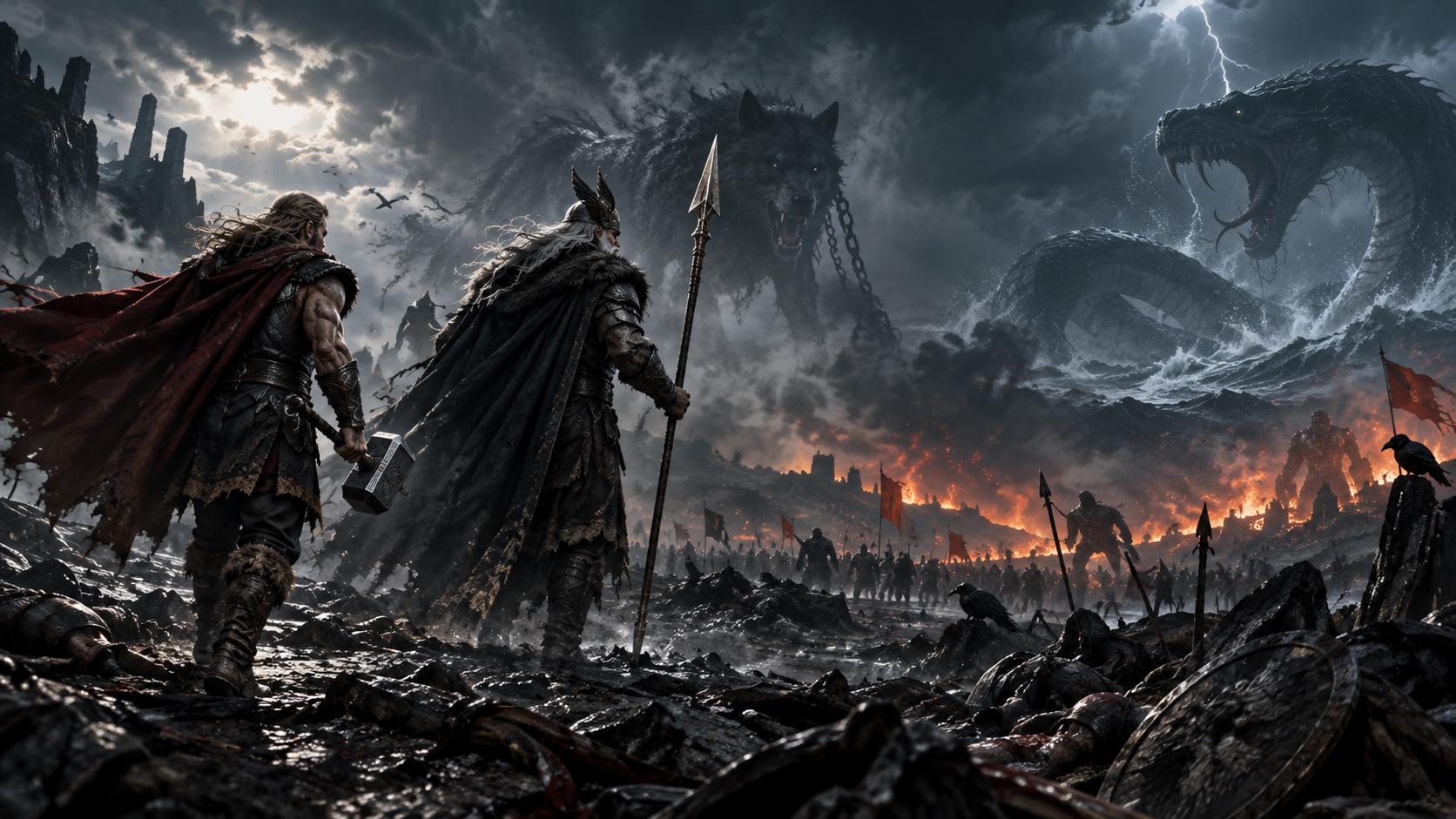
Ragnarök: Why the Norse Gods Fight Even Though They Know They Will Lose
In Norse mythology, the gods are not immortal in the way we often imagine gods to be. They can be wounded. They can be killed. And most remarkably, some of them know how they will die.
Odin knows that the wolf Fenrir will kill him. Thor is destined to destroy the World Serpent, Jörmungandr, only to die moments later from its venom. Freyr will fall to the fire giant Surtr. Heimdall and Loki will kill one another.
They know Ragnarök is coming.
They know that many of them will not survive it.
And still, when the final battle arrives, they fight.
That may be one of the most powerful ideas preserved in Norse mythology. Ragnarök is not simply a story about the destruction of the world. It is a story about courage when victory is no longer guaranteed, honor when fate cannot be changed, and the decision to stand when standing may cost everything.
What Is Ragnarök?
The Old Norse word Ragnarök is generally understood as the “fate” or “doom of the gods.” It describes a sequence of catastrophic events culminating in a final confrontation between the gods and the forces arrayed against them.
The surviving Norse sources describe a world descending into chaos before the battle begins.
A terrible winter known as Fimbulvetr, the great winter, comes upon the world. Social order collapses. Bonds between people fail. Violence spreads.
Then the restraints holding some of the most dangerous beings in the Norse cosmos finally break.
Fenrir, the enormous wolf bound by the gods, escapes.
Jörmungandr, the World Serpent encircling Midgard, rises from the sea.
Loki breaks free.
Surtr advances from the realm of fire.
The enemies of the gods move toward their final confrontation.
And the gods know exactly what is happening.
Ragnarök has begun.
Odin Knows What Is Coming
Few figures embody the tragedy of Ragnarök more completely than Odin.
Odin relentlessly pursues knowledge throughout Norse mythology. He sacrifices one of his eyes for wisdom. He hangs upon the world tree, Yggdrasil, in his pursuit of the runes. He seeks knowledge from seers and from the dead.
But knowledge comes with a terrible price.
Odin learns enough about the future to understand that Ragnarök cannot simply be avoided.
He knows Fenrir is connected to his death.
Yet Odin does not abandon the struggle.
Instead, much of what he does can be understood as preparation.
This gives another dimension to Valhalla.
The warriors brought to Odin's hall are not merely enjoying an eternal reward. The slain warriors known as the Einherjar fight and train, preparing for the battle that will eventually come.
Odin gathers warriors because Ragnarök is approaching.
He knows the battle may end with his death.
He prepares anyway.
Fenrir and the Death of Odin
Fenrir is one of Loki's monstrous children and one of the great threats feared by the gods.
As the wolf grows increasingly powerful, the gods decide he must be restrained. Eventually they bind him using the magical fetter Gleipnir.
But Fenrir does not forget.
When Ragnarök arrives, the wolf breaks free.
Odin rides into battle carrying his spear, Gungnir, confronting the creature he has long known would be part of his fate.
Fenrir kills him.
For the ruler of the Æsir, collector of knowledge and seeker of prophecy, there is no miraculous escape from the destiny he has spent so long trying to understand.
But Odin's death is not the end of the confrontation.
His son Víðarr avenges him by killing Fenrir.
Even within catastrophe, one generation continues the struggle of the one before it.
Thor's Final Battle
Thor faces an equally grim destiny.
His enemy is Jörmungandr, the enormous serpent that lies in the ocean surrounding Midgard.
Thor and the serpent are already established enemies before Ragnarök. Their final confrontation becomes one of the defining battles of the Norse apocalypse.
Thor kills Jörmungandr.
For a moment, it appears that the thunder god has won.
Then he begins to walk away.
He takes nine steps.
And falls.
The serpent's venom kills him.
It is an extraordinary ending for one of mythology's great warrior gods. Thor succeeds in destroying his enemy, but victory does not save him.
His story at Ragnarök captures something central to the mythology:
An action can matter even when the person performing it does not live to see what comes afterward.
The Other Final Battles
Across the battlefield, other ancient conflicts reach their conclusions.
The god Freyr confronts Surtr, the fire giant. According to the surviving tradition, Freyr is disadvantaged because he previously gave away his remarkable sword. He falls in battle.
The watchman of the gods, Heimdall, confronts Loki.
They kill one another.
The hound Garmr and the god Týr also meet in battle and destroy each other.
The world itself seems to collapse around them.
Surtr's fire sweeps across the earth.
The old world ends.
If Ragnarök stopped there, it would be a story of annihilation.
But it doesn't.
The World After Ragnarök
One of the most frequently overlooked parts of Ragnarök is what happens afterward.
The world returns.
A renewed earth emerges, green and fertile.
Some gods survive.
Others return.
Among the survivors are Odin's sons Víðarr and Váli, while Thor's sons Móði and Magni inherit Mjölnir.
Two human survivors, Líf and Lífþrasir, endure the catastrophe and become the ancestors of humanity in the renewed world.
The mythology therefore does not present Ragnarök as simply an ending.
It is destruction followed by renewal.
The old order disappears, but existence continues.
That changes the meaning of the gods' final stand.
They are not necessarily fighting to preserve everything exactly as it was.
They are fighting their part in a larger story whose conclusion extends beyond their own lives.
Why Fight a Battle You Know You Will Lose?
This is where Ragnarök becomes more than an ancient story about gods, monsters, wolves, serpents, and fire.
The Norse gods possess something humans have always wanted:
knowledge of the future.
But that knowledge does not rescue them.
Odin cannot acquire enough wisdom to eliminate every consequence of fate. Thor cannot become strong enough to escape death. Heimdall cannot remain forever at his watch.
Their power has limits.
What remains within their control is how they meet what comes.
That distinction matters.
Courage is easy to celebrate when courage leads inevitably to victory.
Ragnarök presents something harder.
Courage when victory is uncertain.
Duty when survival is unlikely.
Action when the outcome cannot be controlled.
The gods do not fight because they have been promised that everything will turn out exactly as they want.
They fight because when the moment arrives, fighting is what remains theirs to choose.
Fate and Courage in the Norse World
The surviving Norse literature repeatedly wrestles with fate.
A person's ultimate destiny may be fixed, but knowledge of that destiny does not eliminate responsibility for one's actions.
That creates a particular kind of courage.
The courageous person is not necessarily someone who believes nothing bad can happen.
The courageous person understands that something bad can happen and acts anyway.
Ragnarök magnifies that idea to a cosmic scale.
Odin rides toward Fenrir.
Thor walks toward Jörmungandr.
Freyr faces Surtr.
Heimdall confronts Loki.
They do not control the ending.
They control their response to it.
And perhaps that is why these stories survived.
Ragnarök Was Never Just About the End of the World
Modern portrayals often reduce Ragnarök to the Norse version of an apocalypse: gods fighting monsters while the world burns.
The original mythology offers something considerably richer.
Ragnarök asks a question that remains relevant long after the Viking Age:
What do you do when you cannot control what comes next?
The Norse answer is not that strength guarantees victory.
It is not that courage makes someone invulnerable.
It is something more demanding.
You stand.
You fulfill your obligations.
You face what comes.
And when the old world falls, something may remain for those who follow.
That is the deeper power of Ragnarök.
The gods know the battle is coming.
They know the price.
They know some of them will fall.
And when the horn sounds, they still ride to meet it.
Ancient stories endure because the questions inside them never really disappear. Explore our Norse and Viking collection inspired by the gods, warriors, symbols, and ideas that have survived for centuries.
Ancient Words. Legendary Stories. Timeless Ideas.
Wear the story. Carry the meaning.